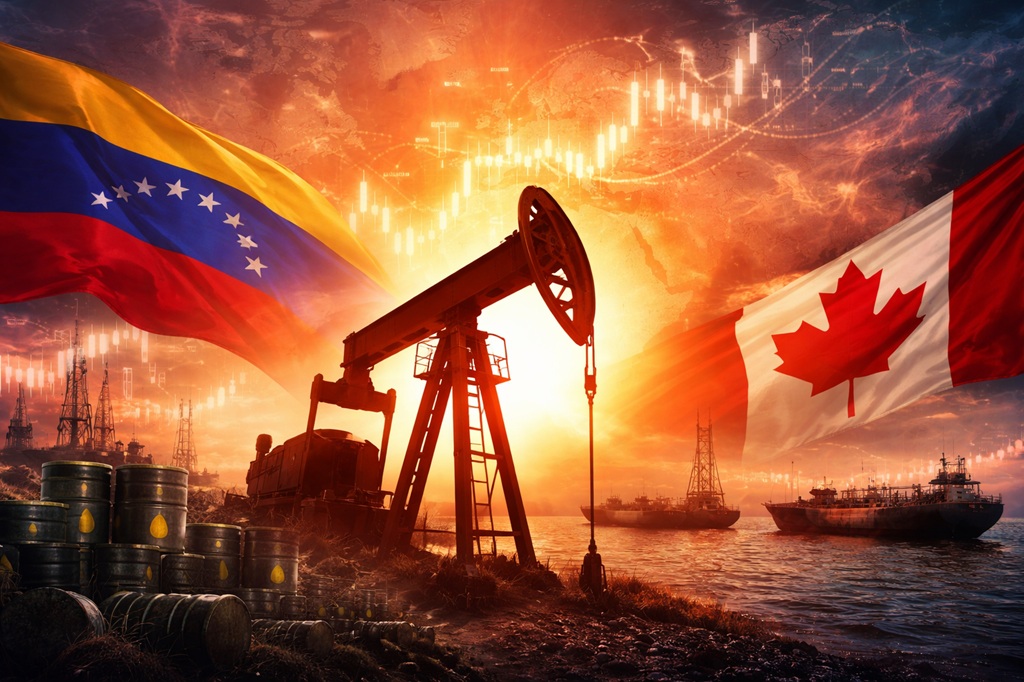
The Oil Mirage: Why Venezuela Won’t Flood the Market
Venezuela’s oil revival is widely misunderstood. This article explains why political change won’t quickly unleash cheap crude, and why Canada’s heavy oil assets remain strategically vital in a fragmented global energy market.
Venezuela, U.S. Power, and the Illusion of Cheap Crude | A Canadian Investor’s Lens
For global oil markets, Venezuela has always been the mirage on the horizon.
A country sitting atop the world’s largest proven oil reserves.
A political basket case for two decades.
And now, after the arrest of Nicolás Maduro, a sudden resurgence of hope that millions of barrels per day could come rushing back onto the market.
If you’re a Canadian investor, especially one exposed to energy equities, oil sands producers, pipelines, or royalties, this moment matters far more than the headlines suggest.
Because Venezuela’s oil story isn’t really about Venezuela.
It’s about how quickly the U.S. can, or can’t, manufacture supply, and what that means for long-term oil prices, capital cycles, and Canada’s place in the global energy stack.
Who Really Controls Venezuela’s Oil?
On paper, the answer hasn’t changed.
Petróleos de Venezuela (PDVSA) still controls the reserves, the fields, and the infrastructure. The nationalization of the 1970s locked that in long ago.
In practice, however, PDVSA is a shell.
Decades of underinvestment, brain drain, sanctions, and corruption have turned what was once a 3.5 million barrel-per-day producer into a struggling system barely pushing ~950,000 bpd, with roughly 550,000 bpd exported, often via opaque “shadow fleets.”
The only Western company with real operational leverage on the ground today is Chevron, operating through joint ventures that still move about 150,000 bpd under sanction waivers. It's also why Chevron's share price soared in the wake of the Venezuela takeover.
Russian and Chinese firms are present. European majors like Repsol and Eni remain involved. But control? It’s fractured, political, and brittle.
The Dangerous Assumption | “The U.S. Will Just Turn It Back On”
The initial narrative we heard in the markets:
If a pro-U.S., pro-investment government emerges, American companies will flood in, production will surge, and oil prices will fall.
But, as we found out and will continue to find out, this assumption is deeply flawed.
Even in the most optimistic scenario, rapid regime change, sanctions lifted, contracts honored, the physical reality is unforgiving:
- Oil fields are damaged and neglected
- Upgraders and pipelines are rusted or offline
- Power, water, and workforce systems are degraded
- Security is far from guaranteed
Industry estimates suggest $10+ billion per year, for many years, just to stabilize production, before any real growth.
This isn’t U.S. shale, where capital converts to barrels in months.
This is heavy, sour crude in one of the most dilapidated oil systems on earth.
Why Canadian Investors Should Pay Close Attention
Here’s where Canada quietly sits at the center of the story.
Venezuela’s crude is heavy and sour, the same type produced in Alberta’s oil sands.
According to energy analyst Andrew McNally, in a Streetwisereports.com article Oil Companies Discover Massive Investment Opportunity in Venezuela's Petroleum Sector:
“U.S. refineries love to slurp that gunky oil from Venezuela and Canada.”
If Venezuela cannot rapidly return to scale, and history strongly suggests it can’t, then Canadian heavy crude remains structurally indispensable to North American refining.
That matters for:
- Canadian oil sands producers
- Pipeline companies
- Royalty and infrastructure plays
- Long-duration energy cash flows
- Every delayed Venezuelan barrel quietly supports Canadian pricing power.
The Short-Term Illusion vs. the Long-Term Reality
Of course, the markets may see a short-term risk premium.
Political chaos could briefly disrupt exports. Traders may tack on $2–$3 per barrel. Stored oil could temporarily hit the market if sanctions ease.
But these are optical effects, not structural shifts. Venezuela only produces about 1 million barrels of oil per day.
The long-term reality is harsher:
- Venezuela cannot flood markets quickly
- The U.S. cannot “manufacture” Venezuelan supply on demand
- Heavy crude scarcity persists
- Global spare capacity remains thinner than believed
For Canadian investors, this reinforces a powerful theme:
Oil is not as abundant, or as controllable, as policymakers pretend.
The Strategic Implication | Oil’s Long Game Isn’t Over
If anything, Venezuela’s turmoil underscores a broader truth your audience already senses:
The world has underinvested in energy for over a decade.
Geopolitics is fragmenting supply chains. And “just bring more oil online” is no longer a credible strategy.
Canada, despite political friction, remains one of the few stable, scalable, rule-of-law heavy crude producers left.
That’s not bearish oil.
It is part of a long-cycle setup.
Final Takeaway for Canadian Investors
Venezuela’s oil headlines may spook markets, but they shouldn’t fool you.
This is very unlikely to be a story about collapsing oil prices.
It’s a reminder that supply is fragile, slow, and political.
And in that world, Canada’s energy assets, often dismissed, often discounted, remain quietly strategic.
The mirage of easy Venezuelan oil may flicker again.
But the barrels that actually matter?
They’re still hard to replace. Nothing proved this more than oil rising, not falling, in the wake of the Venezuela takeover.

Latest Insights
Recent Highlights from Our YouTube Channel
Comprehensive reviews of current market dynamics and the latest trends influencing the future of investments.