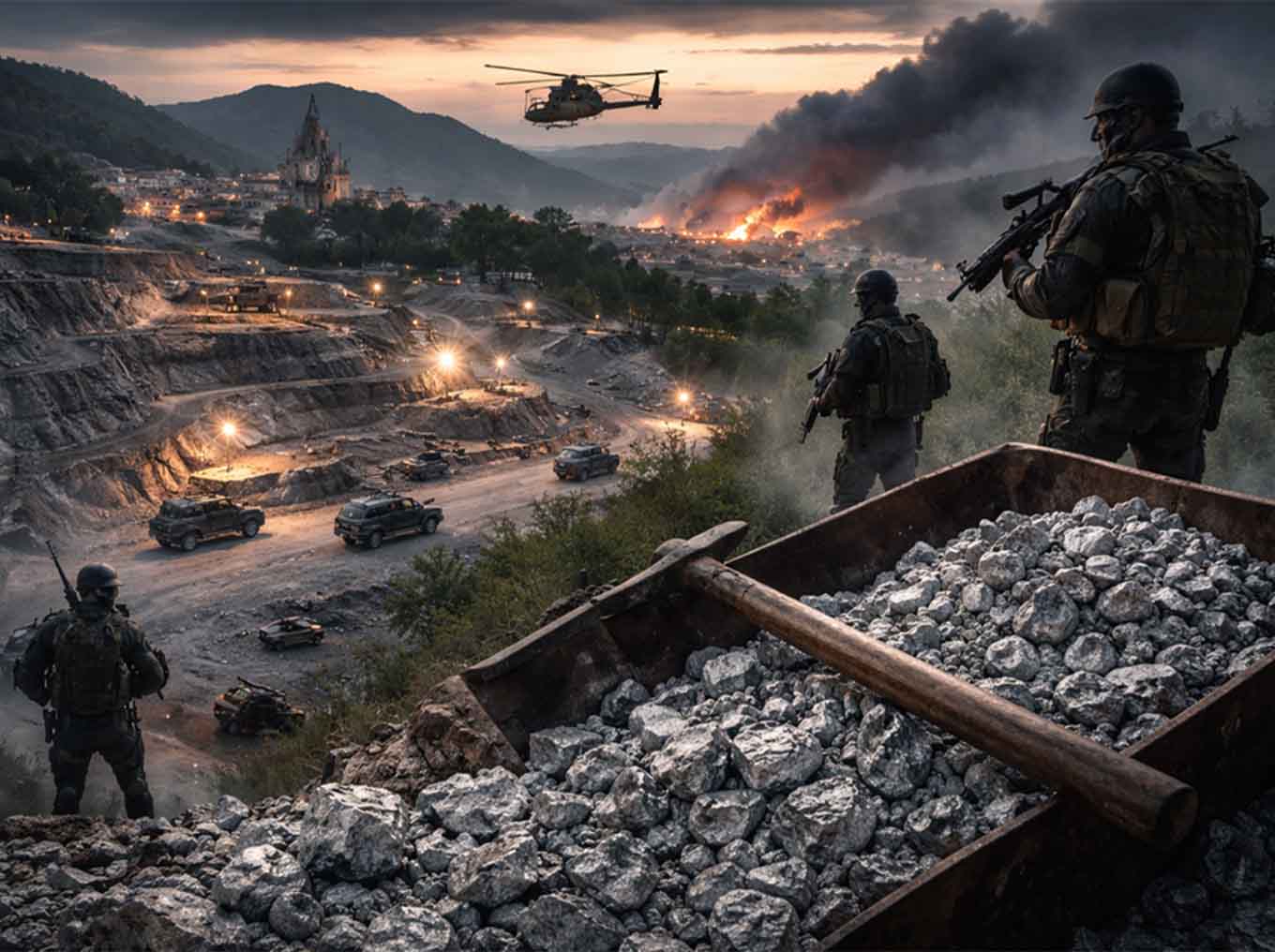
Mexico’s Silver War: Cartels, Politics, and the Rising Risk to Global Supply
For centuries, silver has shaped Mexico’s fortunes and fueled conflict across its mining regions. As cartel violence intensifies in key production states, investors are being reminded that extracting precious metals in Mexico has never been purely about geology. The country’s long and dangerous history with silver may once again collide with global supply.
The Dangerous History of Mining Precious Metals in Mexico
In February 2026, helicopters moved low across the mountains of Jalisco at first light.
Mexican military units advanced toward a remote compound long believed to be controlled by one of the most powerful criminal figures in the Western Hemisphere.
According to Mexican news outlets, the operation ended with the death of Nemesio Oseguera Cervantes, better known as 'El Mencho', the feared leader of the Jalisco New Generation Cartel.
For Mexico’s government, it was presented as a historic victory.
For the country itself, it has unleashed chaos onto the streets and may mark the beginning of something far more complicated; particularly for one of Mexico's most valuable exports: silver.
Within hours, retaliation spread across multiple states. Vehicles burned along highways. Armed blockades shut down major routes. Cities like Guadalajara fell eerily quiet as residents stayed indoors. Schools cancelled classes. Security forces clashed with cartel gunmen across several regions.
Reports suggested dozens of casualties followed the operation, including members of Mexico’s National Guard and security personnel. Authorities deployed thousands of additional troops to stabilize western Mexico as heavily armed cartel fighters responded with military grade weapons and coordinated attacks.
To outsiders, this looked like another chapter in Mexico’s long running drug war.
But investors watching precious metals should understand something deeper. On January 23, 2026, ten employees of Vancouver based Vizsla Silver were abducted by armed groups at the company’s Panuco mining project in the Concordia district of Sinaloa, Mexico. Since then, 5 have been confirmed dead.
The brutal truth is that many of these regions sit directly atop some of the richest silver deposits on Earth. And history shows that when violence intensifies in Mexico, mining rarely remains untouched.
Silver Built Mexico Before Cartels Ever Existed
Mexico’s relationship with silver predates modern politics, modern crime, and even the modern nation itself.
When Spanish explorers discovered vast silver deposits in Zacatecas and Guanajuato in the 1500s, the global economy changed forever.
Mexican silver funded the Spanish Empire. It flowed into Europe, crossed the Pacific to Asia, and effectively became the world’s first global reserve currency. The United States was founded on a bimetallic monetary system, though silver served as the primary circulating standard between 1792 and 1834.
Entire cities rose from mining wealth carved out of rugged mountains far from centralized authority.
And from the very beginning, silver attracted competing power structures.
Local strongmen. Colonial administrators. Rebel armies.
Where silver concentrated wealth, conflict followed.
The pattern would repeat for centuries.
Mexico Today: The World’s Silver Superpower
Fast forward to today, and Mexico remains the undisputed leader in global silver production.
No country produces more. Or even comes close.
From Sonora in the north to Durango, Zacatecas, Chihuahua, and Guerrero, Mexico’s geology continues to deliver extraordinary deposits that attract billions of dollars in foreign mining investment.
According to the Silver Institute, The Silver Market is on Course for Fifth Successive Structural Market Deficit from November 13th:
"Mexican production is predicted to rise 5Moz y/y to 186Moz, supported by the restart of Peñoles’ Tizapa following a prolonged labor strike, the ongoing ramp-up at Endeavour Silver’s Terronera, and higher output at Southern Copper."
For decades, international miners viewed Mexico as one of the most attractive jurisdictions on Earth.
Strong mining culture. Skilled labor force. Established infrastructure.
But beneath that stability, another system was growing. One largely invisible to global investors.
When Cartels Became Economic Actors
Mexico’s cartel economy evolved dramatically after the federal government intensified military operations against drug trafficking organizations in the mid 2000s. More recnetly, as first reported by the New York Post, in an article by Chris Nesi, Trump quietly got Mexico to hand over 100 cartel leaders — including El Mencho’s brother — before Jalisco raid, reports confirm that Mexico quietly handed over nearly 100 suspected cartel figures to U.S. authorities ahead of the Jalisco military operation, including the brother of CJNG leader El Mencho. To think this event is not directly tied to El Mencho and the chaos we now see on the streets of Mexico is naive.
So, as pressure mounted on narcotics routes, criminal groups diversified.
They moved into fuel theft. Agriculture. Logistics. And eventually, natural resources.
According to Mexican media reporting and security analysts, organized crime groups increasingly began targeting mining operations not just for theft, but for control.
Mining companies operating in remote regions suddenly faced new realities:
- extortion demands,
- forced contractor relationships,
- transportation risks,
- and security negotiations that rarely appeared in official filings.
Cartels realized something simple.
A producing mine generates predictable cash flow.
In many ways, it resembles a permanent business operating in isolated terrain.
For criminal organizations seeking stable revenue, precious metals became attractive. With silver above $80 per ounce, very attractive.
The Overlap Investors Rarely See
The same western states shaken by violence following El Mencho’s death are not just cartel strongholds.
They are mining corridors.
Jalisco, Zacatecas, Durango, and neighboring regions form part of Mexico’s broader mineral belt.
This overlap creates one of the least discussed risks in the silver market. Transportation.
Silver supply depends heavily on regions where state authority and non state power structures coexist uneasily.
Most of the time, operations continue normally. Until suddenly, they do not.
Mining history in Mexico shows that disruption rarely arrives gradually.
It arrives overnight. In the form of a a blocked highway. A kidnapped contractor. A shutdown ordered for safety.
Then global supply tightens.
Violence and Silver Have Always Moved Together
What makes today’s situation notable is not that violence exists. It is that it echoes earlier periods of Mexican history.
During the Mexican War of Independence, silver regions became battlegrounds because control of mines meant control of wealth.
During the Mexican Revolution, mining towns again became strategic targets.
Each time silver prices rose or economic importance increased, competing power centers emerged around resource control. We may be entering one of these phases today as silver prices trade near historic highs.
Today’s cartel landscape may simply represent a modern version of an old phenomenon. Different actors. Same incentives.
Why This Matters Now
The killing of a cartel leader might suggest stabilization.
But historically, leadership removals often trigger fragmentation rather than peace.
Rival factions compete for territory. Violence temporarily increases. Control over revenue sources becomes contested.
For the silver industry, that means uncertainty.
And uncertainty in the world’s largest silver producing nation carries global consequences.
Because unlike gold, silver production is heavily concentrated geographically.
There are fewer substitutes. Fewer jurisdictions.
And fewer places capable of replacing lost supply quickly.
Global silver production is highly concentrated. Mexico leads by a wide margin with about 6,300 metric tons annually, followed by China and Peru at just over 3,000 metric tons each, while Bolivia and Chile produce roughly 1,200 to 1,350 metric tons. After these top five producers, output drops off sharply, leaving the global silver market heavily dependent on a number of smaller producers, such as the U.S., Australia and Russia.
Act VI: Are Some States Safer Than Others?
Historically, the answer is yes, but this distinction matters enormously.
Higher Risk Regions
- Guerrero
- Zacatecas
- parts of Sinaloa
These areas have seen rising cartel activity and higher crime perception rankings.
Moderate Risk
- Durango
- Chihuahua
Established mining culture and stronger security presence help reduce operational disruption.
Generally More Stable Mining Jurisdictions
- Sonora
- parts of northern industrial Mexico
These areas benefit from stronger economic diversification and institutional presence.
Understanding regional differences is essential because Mexico is not a single risk environment.
It is a patchwork of local realities.
Act VII: Historical Precedent
Is what we are seeing today unprecedented?
Not at all.
Throughout Mexican history, silver booms have coincided with periods of instability:
- Colonial exploitation fueled rebellion.
- Silver wealth helped finance the Mexican War of Independence.
- Mining regions became battlegrounds during the Mexican Revolution.
Each cycle followed a familiar pattern:
- Rising metal prices attracted capital.
- Wealth concentrated locally.
- Competing power structures emerged.
Today’s cartel involvement may simply represent a modern version of an old dynamic.
Act VIII: The Government Versus the Cartels
Mexico’s federal government continues deploying military forces to stabilize high violence regions tied to organized crime conflicts.
But the conflict is complex.
Cartels are no longer purely drug organizations.
They operate diversified business models involving fuel theft, logistics, agriculture, and increasingly resource extraction.
This makes elimination difficult.
The most likely outcome is not total victory by either side.
Instead, analysts expect an evolving equilibrium where mining companies adapt security strategies while operating within persistent risk environments.
Act IX: Will Silver Get Caught in the Middle?
This is the question investors must consider. As mentioned earlier, Mexico dominates global silver supply. And now cartels are shutting down the arteries of commerce.
If cartel violence or political instability disrupts production even modestly, global markets could feel the impact immediately.
Unlike gold, silver supply chains are tight and heavily dependent on a small number of jurisdictions.
A prolonged security disruption could transform a bull market into a supply shock. In that sense, Mexico may represent one of the most underappreciated geopolitical risks in the silver market.
Final Thought: Silver’s Paradox
Mexico remains one of the world’s greatest mining jurisdictions.
It combines extraordinary geology, experienced labor, and centuries of mining tradition.
Yet the same forces that make silver valuable also make mining dangerous.
High value resources attract competition for control. They always have.
For investors watching the next precious metals cycle unfold, one reality is becoming clearer:
The future price of silver may depend not only on inflation, industrial demand, or monetary policy.
It may depend on whether the world’s largest silver producer can keep its mines operating safely. Many geologists and mining engineers are now refusing to work in Mexico due to safety concerns. What's more, it is becoming almost impossible to achieve transportation insurance for silver. So, with the world's largest silver producer seeing significant disruption, the CME vaults are not being replenished. The structural deficit in silver appears poised to only get worse.
Because in Mexico, silver has never been just a metal. It has always represented power. And, if there is one thing the cartels have and love, its power.

Latest Insights
Recent Highlights from Our YouTube Channel
Comprehensive reviews of current market dynamics and the latest trends influencing the future of investments.