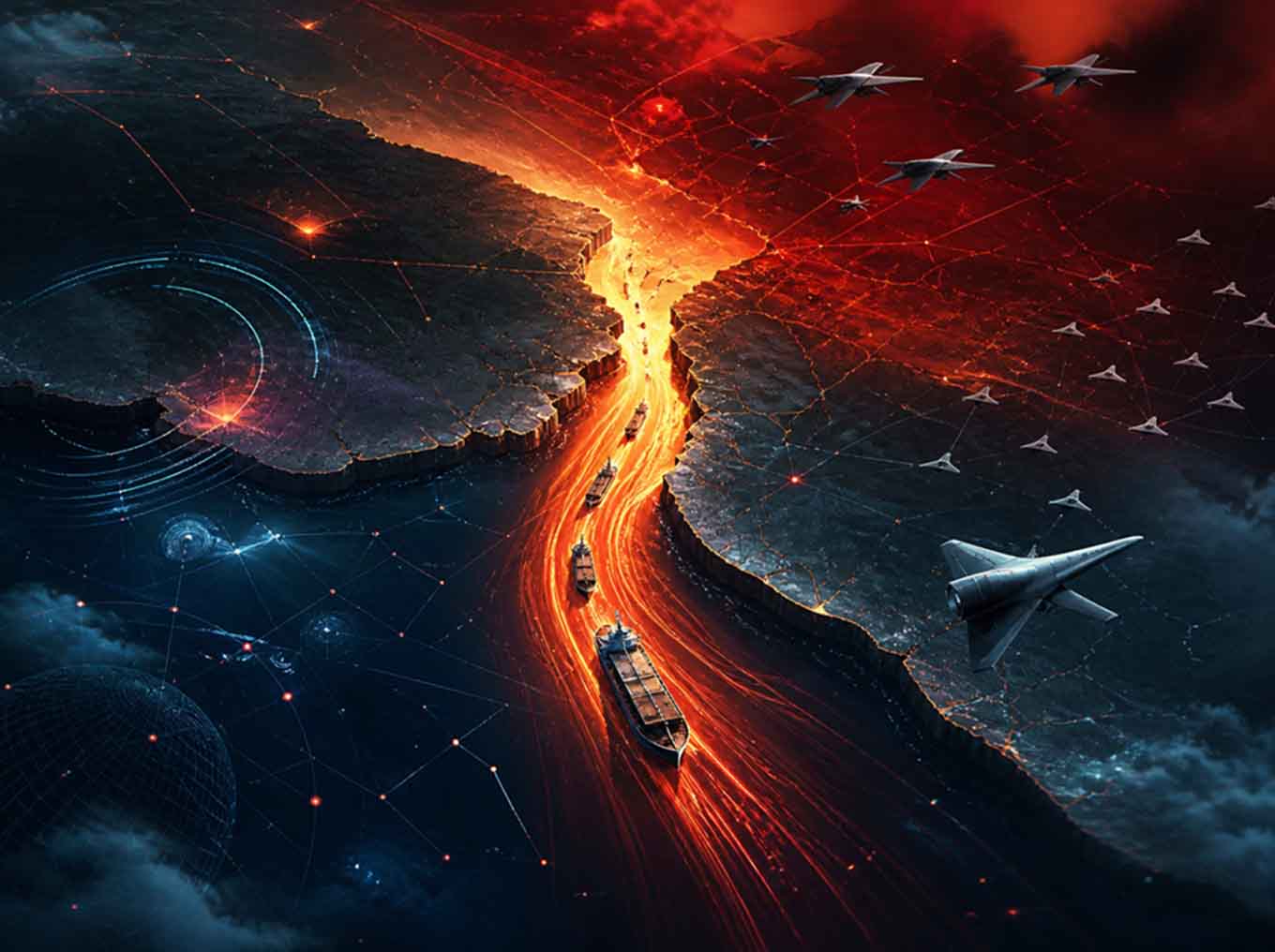
General Petraeus Warns: Iran Is the Crisis, But Ukraine Is the Future of War
General David Petraeus warns that the Iran crisis is not contained as oil surges back above $106 and the Strait of Hormuz remains closed. But the deeper threat may be what Ukraine is revealing now: drones, autonomous warfare, and a new era of geopolitical risk investors can no longer ignore.
Oil Is Back Above $106. The Ceasefire Is Cracking.
The market wanted a ceasefire.
It wanted falling oil, open shipping lanes, and a clean diplomatic off ramp from one of the most dangerous geopolitical confrontations in years.
Instead, oil is back above $106. The Strait of Hormuz remains effectively closed. And the ceasefire investors hoped would hold is now hanging by a thread, if not broken altogether.
That is the backdrop to our conversation with retired U.S. Army four star general and former CIA Director David Petraeus.
And it makes his warning feel less like analysis and more like a flare fired into the dark.
Petraeus did not speak like a market commentator watching crude tick higher. He spoke like a former commander of U.S. Central Command who understands that the Strait of Hormuz is not just a shipping lane.
It is leverage. It is pressure. It is inflation.
It is the global economy being squeezed through one of the narrowest and most important energy chokepoints on Earth.
For investors, the question is no longer whether markets became too optimistic.
The question is whether the world is underestimating how quickly this crisis can mutate.
The Strait of Hormuz Is the Strategic Trap
Petraeus explained why the U.S. and its allies could not allow Iran to emerge from this conflict militarily damaged but strategically empowered.
That is the paradox at the center of the crisis.
Iran’s military may be weakened. Its missile stocks may be degraded. Its navy may be damaged. Its air defenses may be reduced. But if Tehran retains the ability to control the Strait of Hormuz, tax ships, delay cargo, or decide who moves through the Gulf, then it gains something more dangerous than hardware.
It gains leverage over the world.
Petraeus framed it with one of the strongest lines of the interview:
“We can’t allow Iran to turn the Strait of Hormuz into their private Panama Canal.”
That line should be the spine of the article.
Because this is no longer just about Iran. It is about whether one country can hold global trade hostage through a narrow channel of water.
The Strait of Hormuz is only about 21 miles wide at its narrowest point, but it sits at the center of global energy security. When it closes, or even partially closes, the ripple effects can move through oil, natural gas, shipping insurance, fertilizer, transportation costs, food prices, inflation expectations, central bank policy, and consumer confidence.
A ceasefire may calm traders for a few hours.
But a closed strait keeps pressure building underneath the surface.
Petraeus’s point was simple: Iran cannot be allowed to pick and choose who passes through the strait, impose tolls, or turn an international waterway into a strategic weapon.
That is why the latest chaos matters so much.
Oil above $106 is not just a price. It is a warning that the crisis is still alive.
A Ceasefire Is Not Peace
One of the biggest mistakes investors make during geopolitical crises is confusing a ceasefire with resolution.
A ceasefire is not peace.
It is a pause. A test. A fragile arrangement held together by pressure, incentives, fear, and calculation.
Petraeus made clear that negotiations with Iran come down to two absolute issues.
First, the Strait of Hormuz must be restored as an international waterway. Ships must be able to move without Iran imposing tolls, intimidation, or selective control.
Second, Iran’s highly enriched uranium must be dealt with under verification.
Petraeus said Iran reportedly has around 1,000 pounds of uranium enriched to 60 percent. With one more turn of enrichment, he explained, that material could move closer to weapons grade. In his view, the U.S. position is clear: Iran cannot retain the right to further enrichment, and the existing material must be removed, diluted, or otherwise dealt with in a verified way.
His conclusion was blunt:
“These are the absolute redlines for the U.S.”
That is why the current crisis is so dangerous.
Iran needs oil exports. It needs hard currency. It needs ships moving again. It needs access to trade if it wants to rebuild from the damage already inflicted.
But the U.S. also faces pressure.
Higher oil prices feed inflation expectations. Rising gasoline prices hurt consumers. Fertilizer disruptions hit farmers. Transportation costs bleed into everything. President Trump, as Petraeus noted, wants to return to his affordability agenda ahead of the midterms.
This is now a contest of endurance.
Who can absorb more pressure? Who can hold the line longer? Who blinks first?
Hormuz Is the Market’s New Inflation Trigger
For macro investors, this crisis is not just about oil.
It is about the return of inflation risk at exactly the wrong time.
When crude pushes above $100, markets begin to reprice everything. Airlines, trucking companies, farmers, consumers, refiners, chemical producers, and manufacturers all feel it. If fertilizer flows are disrupted, food prices can follow. If shipping routes remain unstable, insurance and logistics costs rise. If inflation expectations return, central banks may be forced to stay tighter for longer.
Petraeus explained that the issue is not simply whether ships can technically pass through the strait. The issue is whether shipowners and cargo owners believe crews can move safely.
He said he had spoken with leaders of major energy companies, and their concern was not just insurance.
It was human risk.
In other words, oil markets trade on headlines, but physical markets trade on confidence.
If crews do not feel safe, cargo does not move normally. If cargo does not move normally, supply tightens. If supply tightens, inflation pressure builds. And if inflation pressure builds, the entire market narrative can flip.
A few days ago, investors wanted to believe the Iran crisis was cooling.
Now the oil market is saying something else.
China Is Quietly in the Room
The Iran crisis also has a China problem.
Petraeus explained that China buys a major share of Iranian crude, but also depends heavily on the Gulf states across the water. That makes Beijing’s position complicated.
China may have strategic sympathy for Iran. It may benefit from a weakened U.S. position in the Middle East. It may see Iran, Russia, North Korea, and itself as part of a loose axis pushing back against Western dominance.
But China also needs stability in the Gulf.
It needs energy. It needs liquefied natural gas. It needs shipping freedom. It needs access to the far wealthier Gulf states that supply far more to China than Iran does.
That is why Petraeus suggested China may be quietly pressuring Iran to reopen the strait and restore normal flows.
He did not overstate the case. But the logic is obvious.
China does not want the Strait of Hormuz permanently disrupted. It does not want energy chaos. It does not want a crisis that pulls the U.S. deeper into the Gulf at the same time Washington and Beijing are managing tariffs, rare earth tensions, and strategic competition.
This is where the story becomes bigger than Iran.
The Strait of Hormuz is now where energy markets, U.S. naval power, Chinese demand, inflation, fertilizer, critical minerals, and great power competition collide.
And Petraeus made another important point: China has already demonstrated its willingness to use strategic chokeholds of its own.
Rare earths. Magnets. Brushless motors. Strategic materials.
The West is now scrambling, along with Canada, to build alternative supply chains.
That matters deeply for Pinnacle Digest readers.
Because the same world that is vulnerable to an oil chokepoint is also vulnerable to mineral chokepoints, semiconductor chokepoints, battery chokepoints, and defense supply chain chokepoints.
The Iran crisis is not isolated.
It is part of a broader fracture in globalization.
Then Petraeus Pivoted to Ukraine
For all the urgency around Iran, the most important part of the interview may have come when Petraeus turned to Ukraine.
That is where the article should widen.
Iran is today’s crisis.
Ukraine is tomorrow’s battlefield.
Petraeus recently returned from Ukraine, his tenth trip since Russia’s full scale invasion. What he described was not traditional war with drones added on top. He described a new kind of battlefield altogether.
His statistic was staggering:
“Ukraine alone is using nearly 10,000 unmanned systems of all types per day.”
That number changes everything.
Drones are no longer niche weapons. They are no longer support systems. They are becoming the core of the battlefield.
Petraeus described aerial drones, surveillance drones, suicide drones, maritime drones, ground systems, remotely driven supply vehicles, remotely controlled weapons, acoustic sensors, radar feeds, and drone interceptors all operating inside one lethal ecosystem.
Then he delivered one of the most powerful lines of the entire conversation:
“This is the most lethal front line in history.”
That line deserves to stand alone in the post.
Because it reveals the deeper point.
The future of war is not coming.
It is already being tested.
Traditional Warfare Is Breaking Down
Petraeus described a battlefield where commanders cannot safely visit front line positions. Vehicles cannot move freely. Troops operate from deeply dug positions. Supplies move at night through remotely driven systems. Casualties are carried back by unmanned vehicles. Anything that emerges into the open is rapidly identified by surveillance drones, then hunted by attack drones.
In his words, traditional combined arms warfare is becoming nearly impossible in certain conditions.
Tanks, armored vehicles, combat engineers, infantry fighting vehicles, air defense, electronic warfare, and maneuver formations are all being forced to adapt to a world of persistent surveillance and cheap precision attack.
This is a massive shift.
For decades, military power was measured by expensive platforms: tanks, jets, ships, missiles, aircraft carriers, and sophisticated air defense systems.
Ukraine is showing that mass, speed, software, sensors, and adaptation may become just as important.
Maybe more important.
That is a terrifying lesson for large military organizations built around slow procurement cycles and exquisite systems.
Petraeus made this point clearly when he contrasted Ukraine’s wartime innovation cycle with Western defense procurement. Ukrainian drone manufacturers, designers, and front line operators are working in direct partnership. Software changes can happen every week or two. Hardware changes can happen every few weeks.
That is not how the West usually buys military equipment.
And that may be the problem.
Ukraine’s Drone Companies Are Exceptional
One of the strongest parts of the interview came when Petraeus discussed Ukraine’s drone companies.
He said he visited three major drone manufacturers. One of them alone is expected to produce three million drones this year. Across Ukraine, production is moving toward seven million drones this year.
His explanation was simple and powerful:
“They’re literally doubling production. It’s extraordinary to see, but it’s because they’re fighting for their very survival.”
That quote should be featured prominently.
Because it explains why Ukraine is innovating so quickly.
This is not a peacetime research project. It is survival pressure. It is battlefield feedback turned into manufacturing. It is war accelerating technology in real time.
And the implications are enormous.
Petraeus said these Ukrainian companies have a window of opportunity. They could export, form joint ventures, build manufacturing facilities abroad, and help allied countries adapt to a battlefield that is changing by the month.
But Ukraine also needs to keep enough production at home, because it is using about 10,000 unmanned systems per day, and that number is likely to rise.
That is the tension.
Ukraine has what the world suddenly needs.
But Ukraine also needs it for survival.
The Next Shock Is Autonomous Warfare
Drones are already reshaping war.
But Petraeus warned that autonomous systems will take this to another level.
Today, many drones still require human pilots. That limits scale. It creates training bottlenecks. It requires communication links. It makes jamming and spoofing effective defensive tools.
But once algorithms pilot the systems, the scale can increase exponentially.
Petraeus explained that autonomous warfare will remove the remote pilot as the limiting factor. Machines will drive, fly, sense, coordinate, and potentially operate in systems of systems. Human beings may still set missions, rules, and boundaries, but the execution could happen at machine speed.
That is the real shock.
Not drones.
Autonomous swarms.
Not one operator controlling one machine.
Algorithms coordinating many machines.
Not war at human tempo.
War at machine tempo.
This is why the Iran crisis and the Ukraine war belong in the same article.
In the Gulf, the world is watching energy chokepoints and naval power.
In Ukraine, the world is watching the future of war being assembled from drones, software, sensors, and battlefield necessity.
And in both cases, the old assumptions are failing.
Why Investors Should Care
The easy investor takeaway is to watch oil.
That is necessary, but not enough.
Oil back above $106 tells us the Iran crisis is not contained. It tells us the Strait of Hormuz still has the power to shock the global economy. It tells us inflation risk can return suddenly. It tells us central banks may not get the clean path to easing that markets want.
But Petraeus’s broader warning points to something even bigger.
The world is entering a new strategic era.
- Energy security matters again.
- Fertilizer security matters.
- Critical minerals matter.
- Rare earths matter.
- Drone supply chains matter.
- Battery inputs matter.
- Semiconductors matter.
- Manufacturing capacity matters.
- Software speed matters.
- Western defense procurement matters.
And countries that once assumed globalization would always deliver cheap supply are waking up to the reality that supply chains can become weapons.
This is where the story lands directly with mining investors as the west races to secure the necessary materials to create these weapons systems.
The future of war is not just a military topic.
It is an investment theme.
It touches oil, gas, uranium, copper, rare earths, defense technology, shipbuilding, semiconductors, AI, sensors, logistics, and North American resource security.
When war changes, procurement changes.
When procurement changes, supply chains change.
When supply chains change, capital flows change.
And when capital flows change, investors who understand the shift early may see the world differently than those still trading yesterday’s assumptions.
The Warning Beneath the Crisis
The market wanted to believe the ceasefire had solved the problem.
But the Strait remains closed. Oil is back above $106. Fresh chaos has reignited fears of a broader conflict. And the world is once again being reminded that geopolitics does not move on Wall Street’s timetable.
Petraeus’s warning is not that every crisis becomes a global war.
His warning is more subtle and more important.
The systems holding the world together are becoming fragile.
Shipping lanes can close.
Energy markets can spike.
Fertilizer flows can be disrupted.
China can use strategic materials as leverage.
Iran can test U.S. resolve.
Russia can grind down Ukraine.
And Ukraine can reveal, in real time, that the future of war has already arrived.
The market is watching oil.
Petraeus is watching Hormuz, uranium, China, drones, and autonomous warfare.
Investors should be watching all of it.
Because this is no longer just a Middle East crisis.
It is a preview of the world ahead, or the world arriving.

Latest Insights
Recent Highlights from Our YouTube Channel
Comprehensive reviews of current market dynamics and the latest trends influencing the future of investments.