Jared Dillian Warns The Old Portfolio Is Breaking
Jared Dillian believes the next decade may look more like the 1970s than the 2010s, with commodities, gold, energy, and international markets potentially outperforming traditional U.S. stock and bond portfolios. He argues that stocks are underpricing recession risk, the dollar remains overvalued, and investors may need broader diversification as the old 60/40 playbook comes under pressure.
For almost twenty years, investors were taught one lesson above all others.
Buy the dip.
When stocks fell, buy them. When valuations looked stretched, ignore them. When the Federal Reserve blinked, trust it. When technology led, follow it. The strategy worked so often, and for so long, that it became more than a tactic. It became a belief system.
Jared Dillian thinks that belief system is now being tested.
The former Lehman Brothers trader, bestselling author, and editor of The Daily Dirtnap returned to Pinnacle Digest Podcast with a warning that cuts against the grain of modern portfolio theory. In his view, the next decade may not reward the investors who simply crowd into U.S. equities, wait for the Fed to rescue them, and assume bonds will provide protection when things go wrong.
Dillian is positioned for a different world. And recently reaffirmed:
“I’m holding 40% of my portfolio in gold.”
For most investors, that sounds extreme. For Dillian, the more dangerous extreme may be the one hiding in plain sight: the standard stock heavy portfolio most people already own.
When he first introduced his AWESOME Portfolio concept, which allocated 20% each to stocks, bonds, cash, gold, and real estate, he was often asked whether 20% gold was too much.
His response was blunt:
“I think 80% stocks is a lot.”
That sentence may be the most important idea in the entire interview.
It flips the question. Instead of asking whether gold is too risky, it asks whether investors have become too comfortable with equity concentration. Instead of asking whether commodities are volatile, it asks whether portfolios built for the 2010s can survive the 2020s. Instead of assuming the old playbook still works, it forces investors to consider the possibility that the market regime has changed.
The Awesome Portfolio Was Built For A Different World
Dillian created the AWESOME Portfolio around 2018. It was not built as a short term gold trade. It was built as a framework for surviving multiple market environments.
The basic idea is simple: own five major asset classes in equal weight. Stocks. Bonds. Cash. Gold. Real estate.
That simplicity is part of its power.
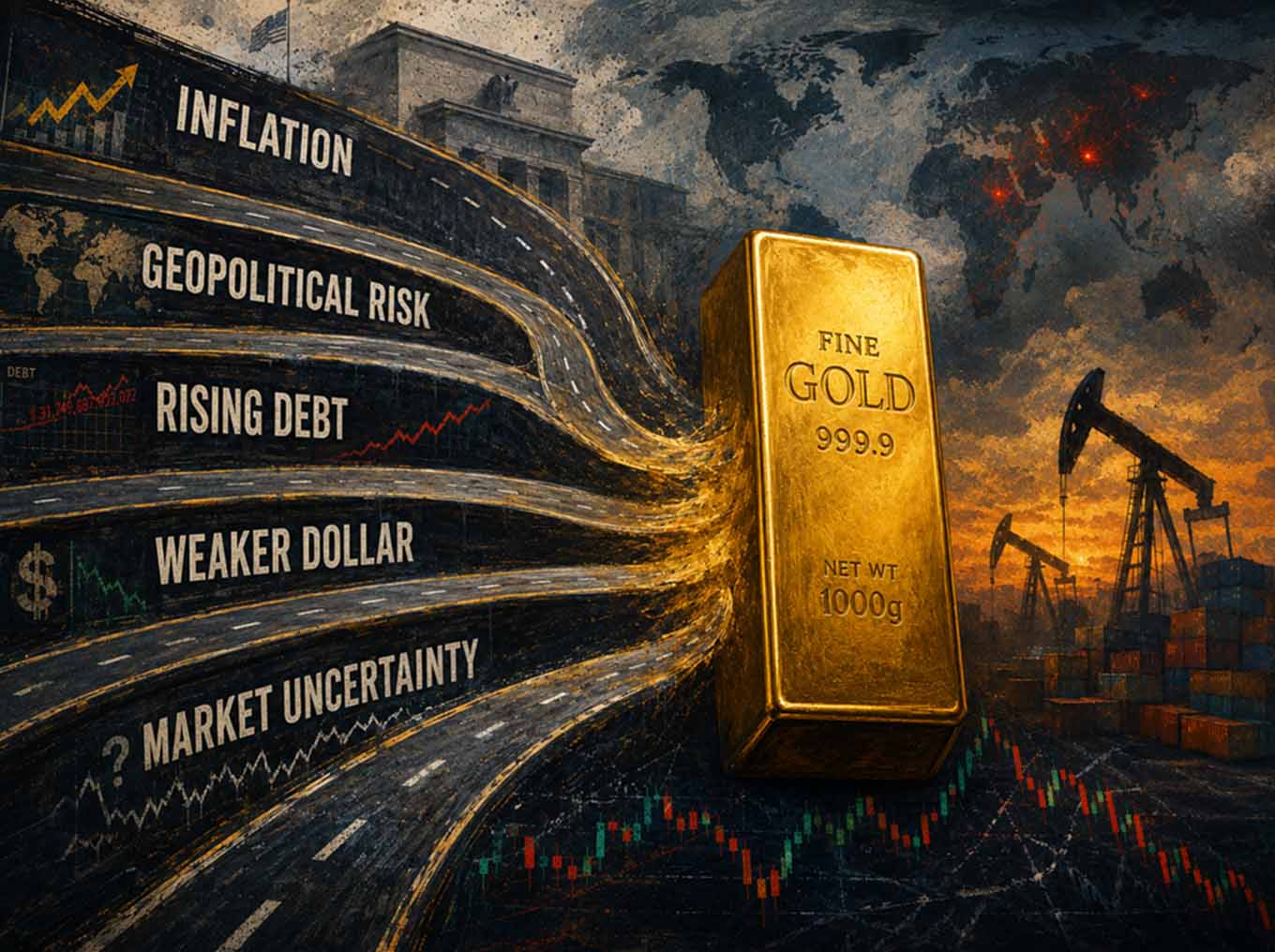
The portfolio is not designed to maximize returns in every bull market. It is designed to avoid becoming dependent on one economic outcome. That matters today because traditional diversification has been under pressure. Inflation can hurt stocks and bonds at the same time. Rising deficits can pressure interest rates. Oil shocks can squeeze consumers and corporate margins. Geopolitical stress can force capital into assets that many investors ignored during the easy money era.
Dillian said the AWESOME Portfolio outperformed the S&P 500 last year by a few hundred basis points, driven largely by gold’s surge.
But he pushed back on the idea that the portfolio is simply a gold bullish call.
“The Awesome Portfolio is not necessarily like a gold bullish call,” he explained. “What it says is that you should have a certain percentage of your assets in commodities and you can use gold as a proxy for all commodities.”
That is the deeper argument.
Gold is not merely a metal in this framework. It is a stand in for scarcity. A hedge against monetary instability. A counterweight to financial assets. A way to own something that does not depend entirely on rising corporate earnings, expanding multiples, or falling interest rates.
For Dillian, the case for commodities is not just cyclical. It is structural.
Gold Has Run, But Dillian Does Not See A Bubble
Gold has already moved sharply higher. Silver has followed. Precious metals sentiment has heated up. Those facts alone make many investors nervous.
Dillian sees it differently.
He remains bullish and believes gold could ultimately reach $10,000 per ounce in the next two to four years, stating,
“I’m still bullish. I think it gets to 10,000 ultimately.”
The reason is not blind enthusiasm. It is what Dillian does not yet see.
He does not see mass retail participation. He does not see the public lining up to buy coins and bars in the way they chased technology stocks, crypto manias, or housing booms. In fact, he said the opposite has happened. As prices rose, many people holding physical gold and silver used the rally as a chance to sell.
“They were actually running out to sell gold and silver. That does not look like an asset bubble to me.”
A true top, in his view, would likely involve the public rushing in, not cashing out.
He also pointed to central bank selling as a reason for confidence rather than fear. Some Middle Eastern central banks have reportedly sold gold into the rally. Dillian is not impressed by the signal.
“Central banks have a pretty terrible track record when it comes to buying and selling gold.”
He referenced one of the most infamous examples in modern gold history: Britain’s decision under Gordon Brown to sell gold near the bottom of the market in the late 1990s.
Dillian’s conclusion was direct.
“Central banks are not going to mark the top of any move. They’re the dumb money.”
Still, he is not pretending gold is risk free. The metal recently corrected sharply. Speculative sentiment in silver and leveraged precious metals products had become overheated. The war acted as a catalyst, but Dillian believes gold likely needed to correct regardless.
More importantly, he acknowledged one uncomfortable development: gold has recently behaved more like a risk asset.
Historically, gold’s value inside a diversified portfolio has come from its low correlation to stocks. If gold starts trading with equities, some of that diversification benefit disappears.
That worries him.
But it has not changed his bigger view.
“There’s going to come a time where I’m going to sell it all,” Dillian said. “I just don’t think we’re there yet.”
Stocks Are Not Pricing A Recession
Dillian’s view on gold is bullish. His view on stocks is far more cautious.
The reason begins with oil.
He pointed out that past oil shocks, including 1973, 1979, and 1990, were usually followed by recession. Today, he believes investors are underestimating the economic damage that can come from higher energy prices and geopolitical disruption.
“If you go back in time, anytime we’ve had an oil shock, which has been 1973, 1979, 1990, it was usually followed by a recession,” he said.
Yet the stock market has not behaved like recession risk is serious. At its lows, Dillian noted, the market was down about 9%.
“Clearly not pricing in a recession,” he said.
His near term expectation is for more downside.
“I think in the short term, I think stocks need to go down about 13 to 15% from the highs,” Dillian said.
That does not mean he is calling for a straight line crash. Dillian thinks like a trader. He sees markets in waves, flushes, bounces, and bases. But his broader warning is that valuations, sentiment, and economic risk do not line up with the confidence still embedded in equities.
He described the current mood through a simple anecdote. Some investors he knows still hold the vast majority of their wealth in stocks. Even after volatility, their main question is when stocks will bottom so they can buy more.
“That’s not the type of sentiment you see at market bottoms,” he said.
That is the danger of a long bull market. Investors stop fearing risk. They fear missing the rebound. After years of successful dip buying, every selloff begins to look like an opportunity. That psychology can support markets for a long time.
Until it breaks.
Private Credit, Real Estate, And The Risks Beneath The Surface
Even if the war ends, Dillian does not believe markets return to normal.
He pointed to private credit and private equity as major unresolved risks. These areas expanded aggressively during the era of easy money. Much of the risk migrated outside public markets, away from daily pricing and broad investor scrutiny.
Higher rates have changed the math.
Commercial real estate remains another pressure point. Inflation has strained consumers. The cost of living has become a political and economic fault line. Dillian’s point is that the market is not facing one isolated threat. It is facing a stack of vulnerabilities built over many years.
That is why the old 60/40 assumption looks fragile.
A portfolio built for falling rates, rising multiples, and abundant liquidity may struggle in a world defined by commodity shocks, geopolitical stress, fiscal deficits, and stubborn inflation volatility.
The 1970s Parallel
Dillian’s long term market outlook increasingly resembles the 1970s.
“In the 70s, stocks returned zero, bonds got killed, commodities did well,” he said. “And if I’m looking out for 10 years in the U.S., I see the exact same environment.”
That may be the central investment thesis of the interview.
Most investors remain positioned for a repeat of the 2010s: low inflation, low rates, U.S. stock leadership, technology dominance, and relentless multiple expansion.
Dillian is positioned for a world where that leadership changes.
He believes September 2024 marked the low in commodities and that a secular bull market has begun.
“I think that in September 2024 that was the low of commodities and we are now in a secular bull market in commodities that will continue for 10 years,” he said.
That does not mean commodities rise every month. Dillian believes oil could pull back if the war ends. But he does not expect oil to return to the old range. In his view, prices may have established a new floor, perhaps closer to $85, $90, or $95.
That has implications across the entire commodity complex.
Energy prices influence agriculture. They influence metals. They influence transportation, mining, manufacturing, and consumer prices. A structurally higher oil price changes the economic backdrop for nearly every asset class.
This is why Dillian has rotated heavily into energy. He also owns international and emerging market assets, especially outside the United States.
If the dollar weakens, that positioning becomes even more important.
The Dollar May Be The Most Mispriced Asset
When asked where he sees the greatest disconnect between value and price, Dillian did not choose gold, oil, or stocks.
He chose the U.S. dollar.
“I think the dollar is the one thing that is the most mispriced,” he said.
His reasoning is rooted in purchasing power. Americans are still travelling abroad and finding many destinations cheap. Europe feels affordable. Japan has become a magnet for tourists. Dillian sees that as a currency signal hiding in everyday behavior.
“If you want to follow currency valuations, just see where people are traveling to,” he said.
In his view, the dollar remains overvalued even after declining. If that changes, the consequences could be profound. A weaker dollar would support commodities. It could revive international equities. It could lift emerging markets after years of underperformance. It could challenge the assumption that U.S. assets will continue dominating global portfolios.
Dillian is already acting on that view. He owns gold, energy, international assets, emerging markets, and Latin America.
He is not waiting for consensus.
Time Horizon Is Everything
One of the most revealing moments in the conversation came during a debate over U.S. real estate.
Dillian is not aggressively bullish on housing, but he is not bearish either. He argues that America still does not build enough homes and that immigration from the prior administration created demand that will not disappear overnight.
The counterargument is demographics. Fertility rates are falling. Family formation is delayed. Younger generations are struggling with affordability. Over decades, that could become a major headwind for housing.
Dillian did not dismiss the point. Instead, he narrowed the difference.
“I can be right in the short term and you can be right in the long term,” he said.
That idea runs through the entire interview.
Gold can correct in the short term and still be in a bull market.
Oil can fall after the war and still trade in a higher structural range.
Stocks can bounce and still face a lost decade.
The dollar can rally during panic and still be overvalued.
Markets are not only about direction. They are about time.
The Old Map May No Longer Work
Every bull market creates a generation of investors who mistake recent history for permanent truth.
The last cycle taught investors to trust U.S. stocks, ignore commodities, treat gold as optional, depend on bonds for safety, and assume the dollar’s dominance would remain unquestioned.
Dillian is challenging that entire map.
He sees a world where commodities matter again. Where gold plays a central role. Where bonds offer little excitement. Where stocks are expensive. Where the dollar may be vulnerable. Where emerging markets and international assets may finally matter after years of neglect.
His 40% gold allocation is not just a number. It is a signal.
It says the age of easy assumptions may be ending.
The next decade may belong to investors willing to own what the last decade taught them to ignore. Commodities. Gold. Energy. Real assets. Foreign markets. Cash when necessary. Diversification that actually diversifies.
The buy the dip era made concentration feel safe.
Dillian’s warning is that the next era may punish that comfort.
And if he is right, the greatest risk may not be owning too much gold.
It may be owning too much of yesterday’s winning trade.

Latest Insights
Recent Highlights from Our YouTube Channel
Comprehensive reviews of current market dynamics and the latest trends influencing the future of investments.