
This Macro Risk Could Destroy the Economy for Decades
Fertility rates across the developed world have collapsed to levels that cannot sustain current populations, yet investors are barely paying attention. By 2040, fewer workers will be supporting more retirees, pressuring pensions, healthcare, housing and entire industries...
When investors discuss the next decade, the same subjects dominate the conversation.
Artificial intelligence. Government debt. Inflation. War. The dollar.
The issue I think about most receives far less attention (almost none): the collapse in fertility rates.
This is not simply a social concern. It’s an economic problem that will affect labour markets, housing, government finances, asset values and the companies investors choose to own.
Modern economies were built around population growth. More people meant more workers, taxpayers, consumers and homebuyers. Pension systems and social programs were designed with the expectation that each generation would be supported by another of similar or greater size.
Across much of the developed world, that assumption is now a myth.
The Collapse Is Already Here
The numbers tell the story. And it’s brutal.
Across the OECD, the average fertility rate fell from 3.3 children per woman in 1960 to 1.5 in 2022, a decline of roughly 55% in little more than six decades. The OECD’s latest family database puts the average even lower, at 1.40 children per woman in 2024. Fertility is therefore continuing to fall from a level already far below the replacement rate of approximately 2.1 children per woman needed to maintain a stable population without immigration.
Canada’s decline has been even more dramatic. The Canadian fertility rate peaked at 3.94 children per woman in 1959. By 2024, it had fallen to a record-low 1.25, a collapse of approximately 68%. Statistics Canada now classifies Canada as an “ultra-low fertility” country.
The European Union recorded only 3.55 million births in 2024, compared with 6.8 million in 1964. In other words, annual births have been cut almost in half. The EU fertility rate reached a historic low of 1.34 in 2024, with Spain at 1.10, Italy at 1.18 and Malta at just 1.01.
This is no longer a forecast about something that might happen. The world’s population WILL decline (the question is how soon), and there will be profound impacts on economics and how humans will live because of it.
The Arithmetic of a Missing Generation
Fertility statistics can feel abstract, so it’s worth reducing the issue to its simplest arithmetic.
At a fertility rate of 2.1, each generation is approximately large enough to replace the one before it. At 1.5, each new generation is only about 71% as large as the previous generation, before considering migration, mortality or changes in the timing of births.
That decline compounds.
The following table is not a formal population forecast. It is an illustrative replacement calculation using the OECD’s 1.5 fertility rate as the starting point.
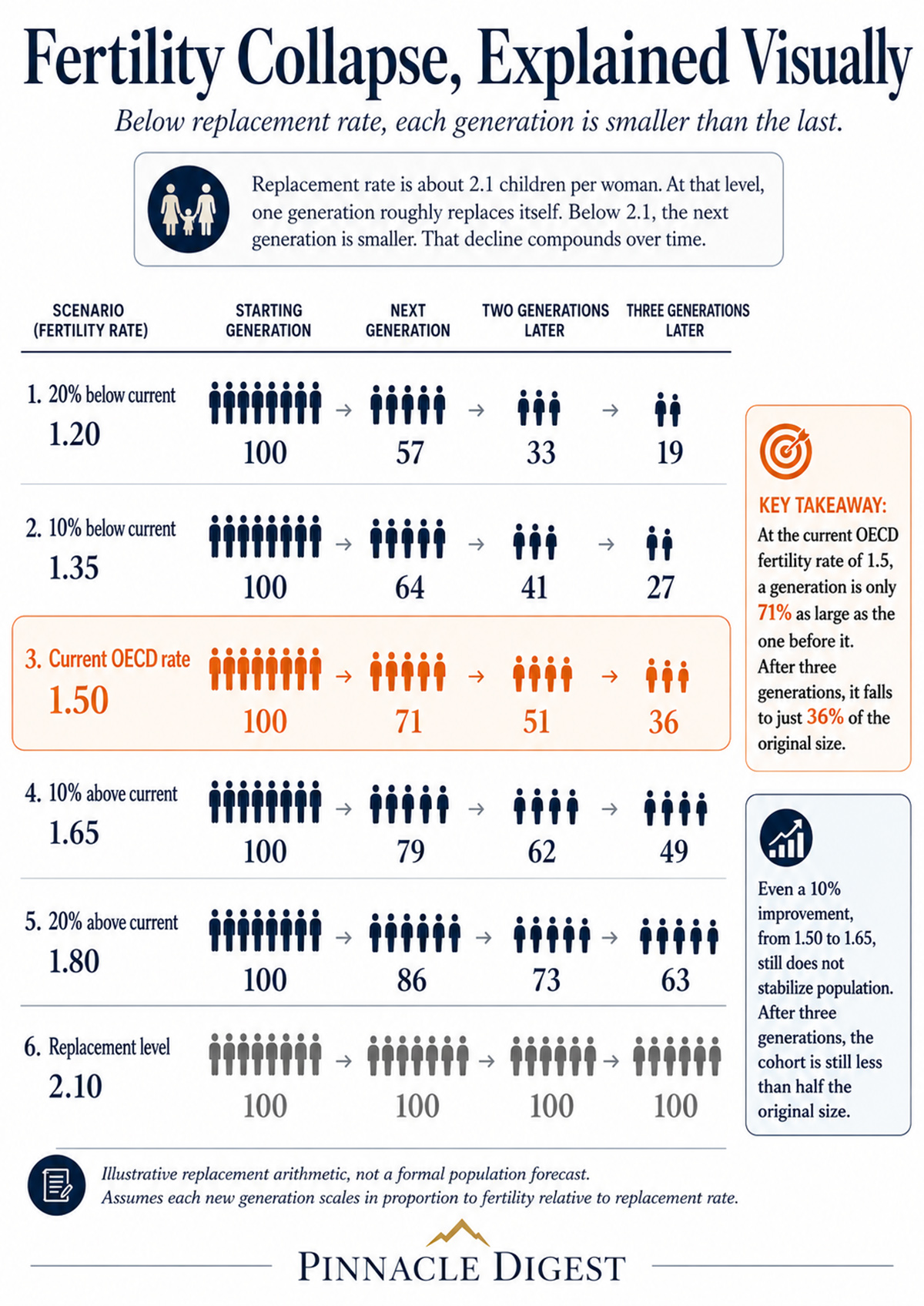
At the current OECD rate, the third generation would be only about 36% as large as the original generation under this simplified calculation.
Even raising fertility by 10%, from 1.50 to 1.65, would not produce population stability. After three generations, the new generation would still be less than half the size of the original one.
The situation is more severe in countries already near 1.2. At that level, each new generation is only about 57% as large as the generation it replaces. After three generations, the resulting cohort would be less than one-fifth the original size.
Population does not decline this quickly because people live for many decades, migration changes national outcomes and age structures create population momentum. However, the exercise shows what extremely low fertility does to the future pipeline of workers, taxpayers and families.
There is another way to frame the risk.
Between 1960 and 2022, the OECD fertility rate declined at a compound rate of approximately 1.3% per year. Mechanically extending that rate of decline would push fertility toward 1.2 by 2040.
By 2040, the Worker-to-Retiree Math Won’t Work
The immediate economic problem is not necessarily falling headline population. It’s the change in the ratio between people working and people drawing age-related benefits.
Demographers commonly measure this using the number of people aged 65 and older relative to the working-age population aged 20 to 64. It is not literally the number of employed taxpayers per pensioner, but it provides a consistent measure of the burden being placed on the potential workforce.
Across the OECD, there were approximately 33 people aged 65 or older for every 100 working-age adults in 2025. That works out to roughly three working-age adults for every senior.
The ratio is expected to reach 40 seniors per 100 working-age adults by 2034 and 52 per 100 by 2050. A simple interpolation between those official projections produces approximately 45 seniors per 100 working-age adults in 2040, or about 2.2 working-age adults for every person aged 65 or older.
That compares with approximately three today and more than four at the beginning of this century.
The actual number of employed contributors supporting each retiree will be lower because not every working-age adult is employed. Some are students, unemployed, unable to work or outside the labour force.
Europe has already moved further down this road. In 2024, the EU had 37 people aged 65 or older for every 100 people aged 20 to 64, leaving fewer than 2.7 working-age adults per senior. Only 20 years earlier, there were approximately 3.7.
This is the pressure point for pensions, healthcare and government finances.
Public pension spending across 31 OECD countries was projected to rise from approximately 8.9% of GDP in the early 2020s to 10% by 2040, even after accounting for reforms already enacted by governments.
A one-percentage-point increase may not sound dramatic. Across economies measured in tens of trillions of dollars, it represents hundreds of billions in additional annual spending.
And pensions are only one part of the bill. Governments must also finance healthcare, long-term care and public services while collecting taxes from a workforce growing more slowly or, in some countries, shrinking outright.
The OECD projects the working-age population across its member countries will fall by approximately 13% over the next 40 years. It estimates that population ageing, without sufficient policy and productivity adjustments, could reduce GDP per person by 14% by 2060.
The political choices eventually become uncomfortable... governments can raise taxes, reduce benefits, increase retirement ages, borrow more money, attract more immigrants or attempt some combination of all five.
None is painless. A combination would likely get a politician voted out of office these days.
The West Can Grow While Its Foundations Shrink
Low fertility does not mean every Western country’s total population will immediately fall.
Immigration can sustain population growth for years or decades. Longer lifespans also mean the overall population can keep growing even as the number of births declines.
But headline population growth can obscure what is happening underneath.
A country can add residents while the ratio between workers and retirees continues to deteriorate. It can grow through immigration while becoming increasingly dependent on a continuous flow of new arrivals to maintain its labour force and tax base.
Migration can materially change the outcome for an individual country. It cannot eliminate the global demographic arithmetic, particularly when the countries supplying migrants are also experiencing declining fertility.
Eurostat’s latest baseline projection shows this tension clearly. The EU population is projected to rise modestly from 451.8 million in 2025 to a peak of 453.3 million in 2029. It then falls to 445 million in 2050 and 398.8 million by 2100.
Under that scenario, the EU would experience 156.7 million more deaths than births between 2025 and 2100. Projected net migration of 103.7 million people offsets much of the natural decline, but not all of it.
More important than the total population is its composition.
Eurostat projects the EU’s working-age population will fall from 263.2 million in 2025 to 198.4 million in 2100, a decline of nearly 65 million people. Over the same period, the number of people aged 65 and older is projected to rise by almost 35 million.
That is an economy with fewer workers and substantially more people requiring pensions, healthcare and assistance.
An Economy Built for More People
Consumption-driven economies need consumers.
Individual businesses can take market share, introduce new products and expand into new regions. At the system level, however, long-term consumption growth is much easier when the population is also growing.
A declining or rapidly ageing population changes the equation.
There are fewer young households forming, fewer first-time homebuyers and fewer workers supporting a growing retired population. Spending gradually shifts away from products associated with young families and toward healthcare, services and products needed later in life.
This does not mean consumption disappears. Older people still consume, often while holding significant accumulated wealth.
But the composition of demand changes.
The economic importance of childcare, schools, starter homes, family vehicles and products aimed at young households may weaken in regions with sustained demographic decline. Demand for healthcare, home modifications, assisted living, wealth management and labour-saving services should grow.
The effects will not appear everywhere at the same time. Demographic change moves gradually, which is one reason markets find it easy to ignore. But slow does not mean unimportant.
By the time the consequences become obvious, much of the outcome has already been determined.
Labour Becomes the Immediate Constraint
The first major investment consequence may be labour scarcity.
Businesses will have to operate with fewer available workers. Qualified employees will become harder to recruit and more expensive to retain. Entire industries may struggle to maintain output because there are not enough people willing or able to perform the work.
The effect will be uneven. Some office jobs can be automated, outsourced or redesigned. Physical work, skilled trades and person-to-person care are much harder to replace.
From an investment standpoint, three broad sectors appear especially exposed.
1. Healthcare and Long-Term Care
Healthcare faces the most direct collision between rising demand and constrained labour supply.
An ageing population requires more doctors, nurses, technicians, personal support workers and long-term care staff. At the same time, many existing healthcare workers are approaching retirement themselves.
The OECD estimates that the number of long-term care workers would need to increase by approximately 60% by 2040 to maintain the current ratio of caregivers to elderly people. That represents an additional 13.5 million workers across OECD countries.
Even assuming substantial productivity improvements and new technology, the OECD estimates that 30% more workers would still be required.
This creates an obvious social challenge, but also a significant investment opportunity.
Diagnostic technology, medical devices, remote patient monitoring, scheduling software, robotic assistance and systems that allow healthcare professionals to treat more patients will become increasingly valuable.
The winning technologies will not necessarily replace doctors or nurses. They will increase the number of patients each trained professional can serve.
2. Construction and Skilled Trades
Construction is vulnerable because it depends on work that is local, physical and difficult to automate completely.
Electricians, plumbers, welders, carpenters, mechanics and heavy-equipment operators are already listed among the most widespread shortage occupations across European labour markets.
This matters because ageing societies still require enormous amounts of construction.
Homes must be renovated for older residents. Electrical grids must be expanded. Factories must be built. Roads, water systems, hospitals and energy infrastructure must be maintained.
The demand for physical infrastructure may remain strong even as the number of people capable of building it declines.
That combination points toward persistent wage pressure, higher project costs and longer construction timelines. It also increases the value of prefabrication, modular building, autonomous equipment, construction software and companies capable of completing projects with fewer workers.
3. Manufacturing, Transportation and Logistics
Western governments are attempting to rebuild domestic manufacturing, strengthen military and industrial supply chains and reduce dependence on geopolitical competitors.
That process requires workers.
It requires machinists, technicians, mechanics, engineers, warehouse employees, equipment operators and truck drivers. Many of these occupations are already experiencing shortages. Heavy-truck drivers and industrial machinery mechanics have repeatedly appeared among Europe’s most widespread shortage occupations.
Reindustrialization and demographic decline are therefore moving in opposite directions.
Governments want to produce more domestically at the exact moment the domestic workforce is becoming older and, in many places, smaller.
The result could be more inflationary than investors expect.
Factories will require more automation. Warehouses will rely more heavily on robotics. Transportation networks will need autonomous and semi-autonomous systems.
Manufacturers with modern equipment and high output per employee should have a growing advantage over labour-intensive competitors.
Why AI Matters More in an Ageing Economy
This is one reason I take automation seriously.
The best automation companies will do more than help customers reduce costs. They will help businesses continue operating when the required labour is unavailable at any reasonable price.
Robotics, industrial software, diagnostic systems, logistics technology and tools that eliminate repetitive administrative work all become more valuable in that environment.
AI is often framed as a threat to employment.
In an ageing economy, it may also become essential to preventing labour shortages from turning into declining output and chronically higher costs.
The critical investment question is not simply whether a company uses AI.
It is whether that technology allows the company or its customers to produce materially more output per worker.
A shrinking workforce does not guarantee economic decline if productivity per worker rises fast enough. But the productivity hurdle becomes higher every year the working-age population contracts.
The Asset Question
Demographic decline should also influence how investors think about assets.
A property, business or infrastructure project may look attractive because demand has risen for decades. That does not guarantee demand will continue growing under a different population structure.
Housing is a good example.
Falling fertility does not mean every city will suffer declining house prices. People can continue moving toward prosperous cities even as the national population stagnates. Immigration, smaller household sizes and regional employment growth can support housing demand.
The likely result is not uniform decline. It is greater divergence.
Cities attracting workers, investment and immigrants may continue growing. Regions losing young adults could face falling school enrolment, weaker retail demand, deteriorating municipal finances and an expanding inventory of homes that older residents eventually need to sell.
Investors should therefore ask which assets require a continuously expanding customer base and which become more valuable as labour, healthcare capacity and productive workers become scarce.
The answer will vary sharply by country, region and industry.
Some businesses will gain market share by serving older customers. Others will discover that their long-term growth assumptions were built on demographics that no longer exist.
What Investors Should Be Watching
Investors spend enormous effort forecasting interest rates and quarterly earnings.
Far less time is spent asking who will be working, consuming and paying taxes 10 or 20 years from now.
That’s a mistake.
The most important demographic figures may not be total population. Investors should pay closer attention to the working-age population, the ratio of workers to retirees, regional migration, household formation and productivity per employee.
They should also examine the age of a company’s workforce.
A business may report strong current earnings while facing the retirement of a large portion of its skilled employees. If those workers cannot be replaced, the company may be forced to pay much higher wages, reduce output or spend heavily on automation.
Companies that can increase output without proportionately increasing headcount should become more valuable.
Companies whose growth requires continuously hiring more scarce workers may become less valuable, even when demand for their services remains strong.
The Macro Risk Beneath Everything Else
Fertility affects almost everything beneath the economy.
It shapes labour supply, fiscal capacity, consumption, housing demand, inflation and the political choices governments will eventually be forced to make.
It also interacts with nearly every other major investment theme.
Government debt becomes harder to manage when the tax base grows more slowly.
Reindustrialization becomes more expensive when skilled workers are scarce.
Healthcare spending rises as the population ages.
Artificial intelligence and robotics become more valuable when businesses cannot find enough people to perform essential work.
And asset values become increasingly dependent on whether a region is attracting or losing working-age residents.
None of this means the West is destined for economic collapse. Productivity can rise. Retirement ages can change. Immigration can help. Technology can compensate for part of the labour shortfall.
But compensation is not the same as avoiding the problem.
Babies born today will not begin entering the full-time workforce until the late 2040s. Even an immediate and sustained fertility recovery would therefore do little to relieve the labour pressure arriving over the next 15 years.
The companies capable of producing more with fewer workers may become some of the most important investments of the next decade.
The assets located in regions still attracting young people and productive capital may increasingly separate themselves from everything else.
In my recent conversation with Andy Schectman, I explained why fertility collapse is the macro issue I return to more than any other.
It moves slowly, receives little attention and sits underneath almost every major economic forecast.
That is exactly why investors should be paying attention now.

Latest Insights
Recent Highlights from Our YouTube Channel
Comprehensive reviews of current market dynamics and the latest trends influencing the future of investments.