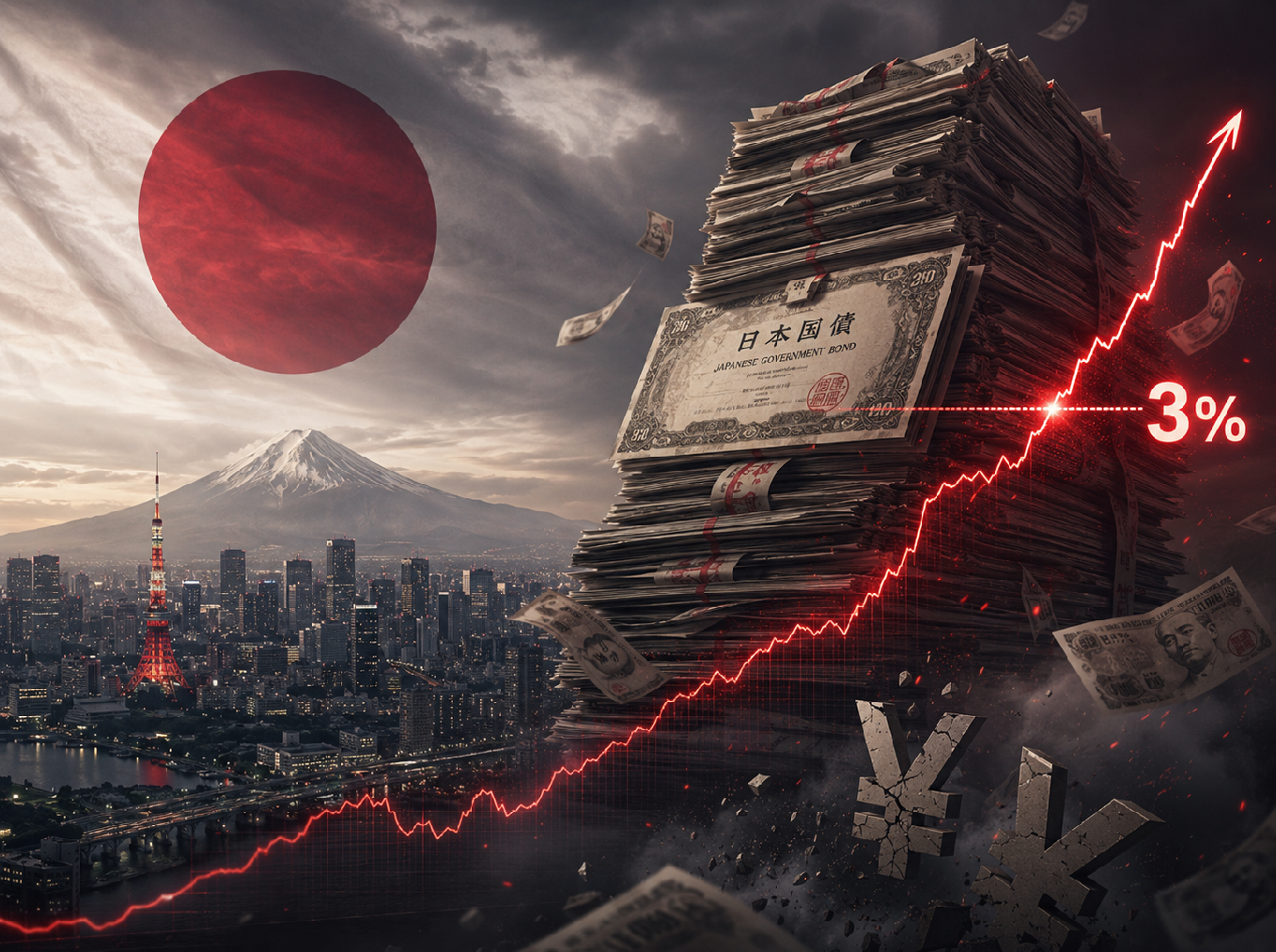
Japan’s Debt Trap: What Happens When a ¥1.35 Quadrillion Debt Machine Meets 3% Interest Rates?
Japan’s ¥1.35 quadrillion debt load was built for a world of near-zero interest rates. With 10-year government bond yields now above 3%, rising refinancing costs, a weakening yen and persistent inflation are pushing the country toward an increasingly difficult fiscal and monetary crossroads.
Japan may be approaching one of the most consequential financial turning points in modern economic history.
On September 1, 2026, the yield on Japan’s benchmark 10-year government bond climbed above 3% for the first time since 1996. For most countries, a 3% government borrowing rate would hardly constitute an emergency. For Japan, however, it represents a fundamental break from the financial system the country has spent decades building.
Japan’s central government debt stood at approximately ¥1.347 quadrillion as of June 30, according to Japan’s Ministry of Finance. That does not make Japan the largest debtor in absolute dollar terms, but Japan remains one of the most heavily indebted major economies in the world relative to the size of its economy.
For decades, that enormous Japanese government debt was manageable because borrowing costs were extraordinarily low. The Bank of Japan suppressed interest rates, purchased huge quantities of Japanese government bonds, and eventually pushed policy rates below zero. Japan effectively built a massive sovereign debt structure around the assumption that money would remain almost free.
That assumption is now being tested.
Japan’s Interest Bill Is Beginning to Explode
Japan does not suddenly have to pay 3% interest on every yen it owes. Much of its government debt was issued years ago at substantially lower rates and will reprice gradually as those bonds mature.
That distinction matters, but it does not eliminate the problem.
Japan’s Ministry of Finance estimates that roughly ¥150 trillion of government debt will require redemption or refinancing annually through the late 2020s. Its projections show approximately ¥150.3 trillion requiring redemption in 2026, ¥150.7 trillion in 2027, ¥151.3 trillion in 2028 and ¥150.3 trillion in 2029.
Each year, therefore, another enormous portion of Japan’s legacy low-rate debt must be replaced in a dramatically more expensive bond market.
The Ministry of Finance already expects interest-related costs to rise from approximately ¥13.2 trillion in 2026 to ¥15.6 trillion in 2027, ¥18.7 trillion in 2028 and ¥21.8 trillion by 2029.
That represents an increase of roughly 65% in only three years.
And that is before contemplating what could happen if yields remain around 3% or move toward 4%.
Japan currently collects approximately ¥83.7 trillion per year in tax revenue.
If Japan’s average interest cost eventually approached 3% across its roughly ¥1.35 quadrillion debt load, simple arithmetic implies an annual interest burden approaching ¥40 trillion.
That would equal almost half of current annual tax revenue.
At an average cost of 4%, the theoretical interest bill approaches ¥54 trillion, equivalent to roughly 64% of current tax revenue.
This would not happen overnight because the debt reprices gradually, but it demonstrates why the direction of Japanese interest rates matters so much. Japan built its fiscal system for a world in which government borrowing costs hovered around zero. A sustained 3% to 4% environment creates a completely different equation.
The Yen Has Already Been Sending a Warning
The Japanese yen has been deteriorating for years.
Through much of the 2010s and early 2020s, one U.S. dollar generally purchased roughly ¥100 to ¥120. The yen subsequently weakened dramatically as Japan maintained extraordinarily loose monetary policy while the Federal Reserve and other central banks raised rates.
By April 2024, the yen briefly weakened beyond ¥160 per dollar, its lowest level in more than three decades. Reuters calculated at the time that the currency had lost roughly 11% during 2024 alone and had been weakening against not only the dollar, but also the euro, Chinese yuan and Swiss franc.
The problem has not disappeared.
In 2026, the yen has again traded around ¥160 per dollar despite intervention efforts designed to support it. Some economists have warned that it could eventually weaken beyond ¥170 if Japan fails to restore confidence in its fiscal and monetary framework.
That weakness matters because Japan imports much of the energy and raw materials it consumes. A weaker yen raises the domestic cost of oil, natural gas, food and other imported products.
This creates one side of Japan’s policy trap.
If the Bank of Japan keeps interest rates too low, capital can continue leaving the yen in search of higher returns elsewhere. The currency weakens, imported goods become more expensive and inflationary pressure rises.
If the Bank of Japan responds by raising rates aggressively, however, the government’s enormous debt burden becomes increasingly expensive to refinance.
Inflation Has Changed the Japanese Economy
For years, policymakers worried that Japan could not generate enough inflation.
That era has ended.
Japan has recentley experienced its strongest inflation in decades after the pandemic, with core consumer inflation reaching multi-decade highs as energy, food and imported goods became more expensive. Inflation subsequently moderated, with nationwide core CPI running around 1.8% in July 2026, but wholesale inflation remained much hotter at approximately 7.2%.
The Bank of Japan also acknowledges that underlying inflation has contributed to the rise in long-term Japanese government bond yields.
This is critical because the Bank of Japan can no longer simply print unlimited amounts of money without consequences.
During Japan’s deflationary era, creating money and buying government bonds carried relatively limited inflationary risk. Today, renewed quantitative easing or aggressive yield-curve suppression could weaken the yen further and feed directly into higher import prices.
That leaves the Bank of Japan with increasingly unattractive choices.
Japan’s Three Realistic Options
Japan theoretically has several ways out, but none is painless.
The first is fiscal austerity. Tokyo could raise taxes, reduce spending, reform pensions and entitlement programs, and attempt to shrink future government deficits. Politically, however, this is extremely difficult in an aging society where social-security spending already represents an enormous share of the national budget.
The second option is to tolerate higher interest rates and hope economic growth and tax revenues rise quickly enough to offset the higher debt-service burden. This would represent the cleanest long-term solution, but Japan would have to survive the transition as enormous quantities of debt refinance at increasingly expensive rates.
The third option is the path financial markets should probably watch most closely: renewed financial repression.
If bond yields rise too far or too quickly, the Bank of Japan can step back into the market and buy Japanese government bonds. In fact, the BOJ has explicitly stated that if long-term interest rates rise rapidly, it is prepared to increase bond purchases.
That might stabilize government borrowing costs.
But it could come at the expense of the yen.
And that is why the likely endgame may not look like a conventional bankruptcy. Japan borrows overwhelmingly in its own currency and has its own central bank. The government can almost certainly create the yen necessary to meet nominal obligations.
The more important question is what those yen will be worth.
Could China Make Japan’s Problem Worse?
There is no credible evidence that Beijing is deliberately attacking Japan’s government bond market or attempting to trigger a Japanese sovereign debt crisis.
There is, however, evidence that China is willing to use economic pressure against Japan when geopolitical disputes intensify.
Following Prime Minister Sanae Takaichi’s comments regarding Taiwan, China restricted shipments of important rare-earth materials to Japan. Reuters reported in July that Japanese companies were increasingly warning about shortages of terbium, dysprosium and other critical minerals used in automobiles, electronics and defense equipment.
That does not directly cause Japanese bond yields to rise, but it can worsen the underlying economic problem.
China dominates key portions of global critical-mineral processing and competes directly with Japan across automobiles, electronics, batteries and advanced manufacturing. Restricting inputs to Japanese manufacturers can hurt production, increase costs and place additional pressure on an economy already coping with higher energy prices and a weak currency.
There is also a broader competitive currency dynamic. China has been actively restraining appreciation of the yuan to protect its export sector despite a massive trade surplus.
A weak or managed Chinese currency combined with aggressive industrial subsidies puts additional competitive pressure on Japanese manufacturers.
Beijing does not need to engineer Japan’s fiscal crisis to benefit strategically from a weaker Japanese economy. If Japan is forced to spend more on debt service, defend its currency and subsidize domestic supply chains simultaneously, its room to project economic and geopolitical power becomes more constrained.
How Does Japan’s Debt Crisis End?
The most likely ending is probably not a dramatic announcement that Japan has defaulted.
It is more likely to be a prolonged struggle between three forces: higher bond yields, a weaker yen and Bank of Japan intervention.
If yields continue rising, debt-service costs consume an ever-larger share of government revenue. If the Bank of Japan responds by suppressing those yields through renewed bond purchases, the yen risks another decline. A weaker yen raises import prices, which feeds inflation and creates pressure for higher interest rates.
That circular relationship is the Japanese debt trap.
There are ways out. Faster productivity growth, stronger nominal GDP, fiscal restraint and sustained increases in tax revenue could gradually reduce the debt burden relative to Japan’s economy.
But markets are increasingly demanding evidence that those improvements will actually happen.
Japan’s government has already seen its 10-year borrowing cost move above 3% for the first time in 30 years, and Finance Minister Satsuki Katayama has publicly acknowledged the need to maintain close communication with markets as yields rise.
Japan spent decades proving that an enormous government debt load could survive when interest rates were close to zero.
The next several years may answer a much more important question: can the same system survive when money is no longer free?

Latest Insights
Recent Highlights from Our YouTube Channel
Comprehensive reviews of current market dynamics and the latest trends influencing the future of investments.