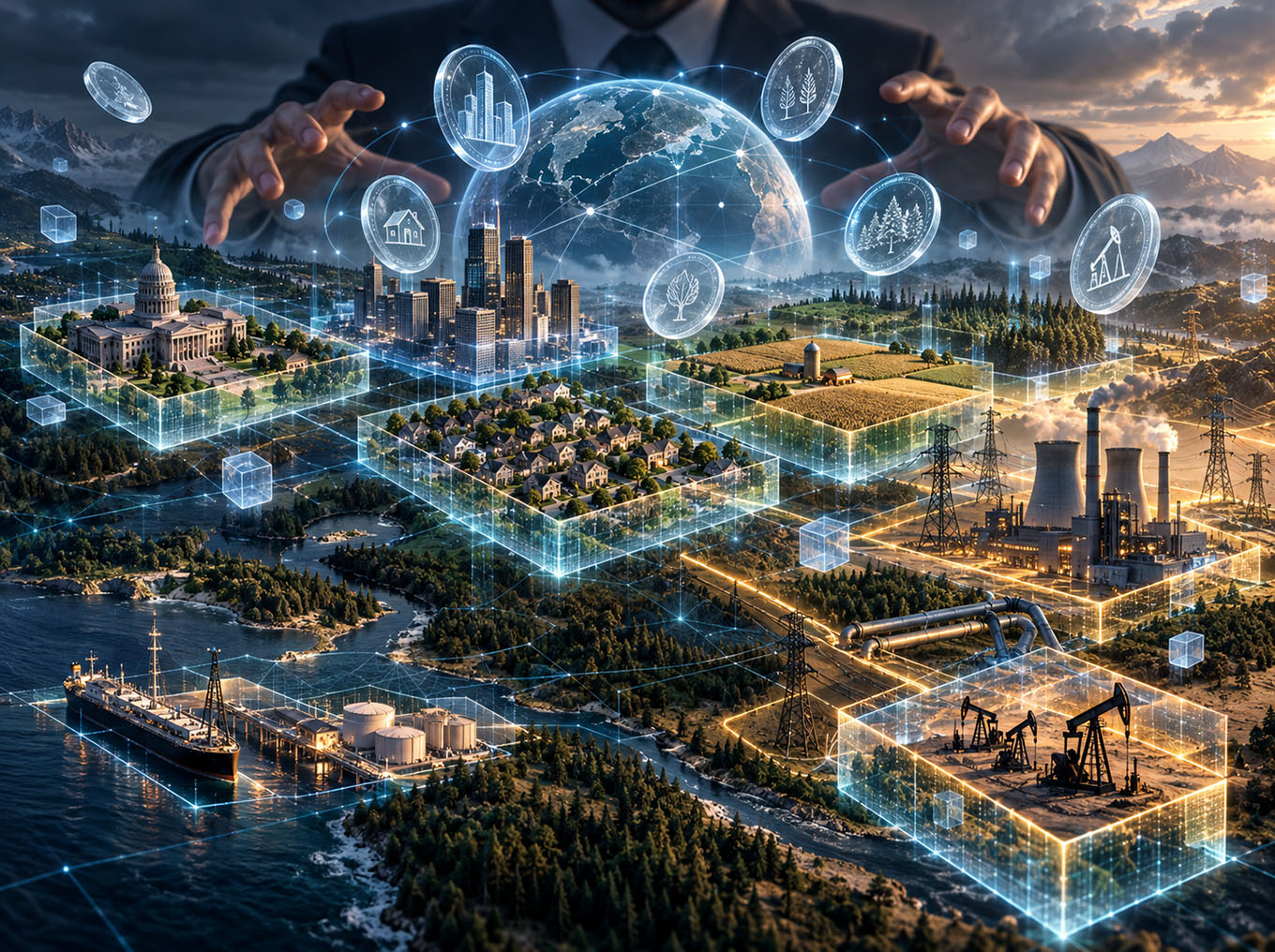
Wall Street Wants to Tokenize Everything
Wall Street says tokenization is about efficiency. David Morgan thinks it may be about something much bigger: turning real estate, government land and eventually the physical world itself into collateral for America’s debt machine.
What if America’s $40 trillion debt problem is not solved by paying down the debt?
What if the solution is to find more things to borrow against?
That was one of the more interesting ideas David Morgan raised during our latest podcast.
Morgan has spent decades studying money, precious metals and the financial system. But this time, our conversation moved into something much bigger than gold.
Tokenization.
Wall Street is pushing to tokenize stocks, bonds, real estate and other assets. The basic idea sounds harmless enough. Take something that exists in the real world, create a digital token that represents ownership of it, then make that token easier to buy, sell or transfer.
Sounds efficient.
Morgan sees something else.
He thinks tokenization could eventually allow enormous amounts of real-world property to be pulled deeper into the financial system.
And that includes something most people almost never think about... Government land.
During our conversation, Morgan imagined what could happen if federally owned land were tokenized. Once an asset has a digital representation, it could potentially be divided, valued, traded and, most importantly, used as collateral.
That last word is everything.
Collateral is what allows debt to grow.
Your mortgage is backed by your house.
A car loan is backed by the car.
A business loan might be backed by equipment, buildings or other assets.
Morgan’s question was simple: What happens when governments begin applying that logic to much larger pools of real assets?
Land.
Real estate.
Mineral rights.
Forests.
Water.
Energy assets.
Infrastructure.
Potentially almost anything that can be assigned a value.
Morgan described a world where land, trees, streams and other physical assets could be brought into a tokenized system and then used to support more borrowing.
That is where this gets interesting.
America does not have a shortage of debt.
It has a shortage of easy ways to keep expanding that debt without eventually damaging confidence in the currency or the bond market.
Morgan pointed out that the United States has already passed $40 trillion in federal debt. He argued that the real limit may not be the number itself. The real limit arrives when investors stop financing the government at rates it can afford.
So imagine you are trying to keep the machine running.
You could raise taxes.
Not popular.
You could cut spending.
Also not popular.
You could inflate away part of the burden.
Governments have done that before.
Or you could find new collateral.
That is Morgan’s theory.
And suddenly Wall Street’s obsession with tokenization looks different.
Morgan believes Wall Street likes tokens partly because a token becomes an intermediary between the person and the underlying asset. Instead of directly holding the thing, you hold a digital representation of the thing.
That creates convenience.
But it can also create control.
A token can potentially be tracked, restricted, divided, transferred or programmed in ways a physical asset cannot.
Morgan put it more bluntly during the podcast when I asked why Wall Street was pushing tokenization so aggressively.
His answer was one word:
“Control.”
Now combine the two ideas.
Wall Street gets a financial system where more assets can be traded digitally.
Governments potentially get a system where more of the physical world can be valued and used as collateral.
And the debt machine gets a larger asset base sitting underneath it.
That does not mean this will happen exactly as Morgan predicts. He repeatedly acknowledged that his vision could face political, legal and public resistance.
But the direction is worth watching.
Because tokenization may not stop with your brokerage account.
It may eventually reach the things beneath the brokerage account.
The office building.
The farmland.
The power plant.
The oil field.
The forest.
The government land.
The physical world itself.
For investors, the question is no longer simply, “Which token should I buy?”
A better question might be:
What real asset is the token actually tied to, who controls it, and what rights do I truly have?
That distinction could become extremely important.
Because if Morgan is right, the great financial innovation of the next decade may not be creating new assets.
It may be finding a way to put a digital wrapper around the ones that already exist.

Latest Insights
Recent Highlights from Our YouTube Channel
Comprehensive reviews of current market dynamics and the latest trends influencing the future of investments.