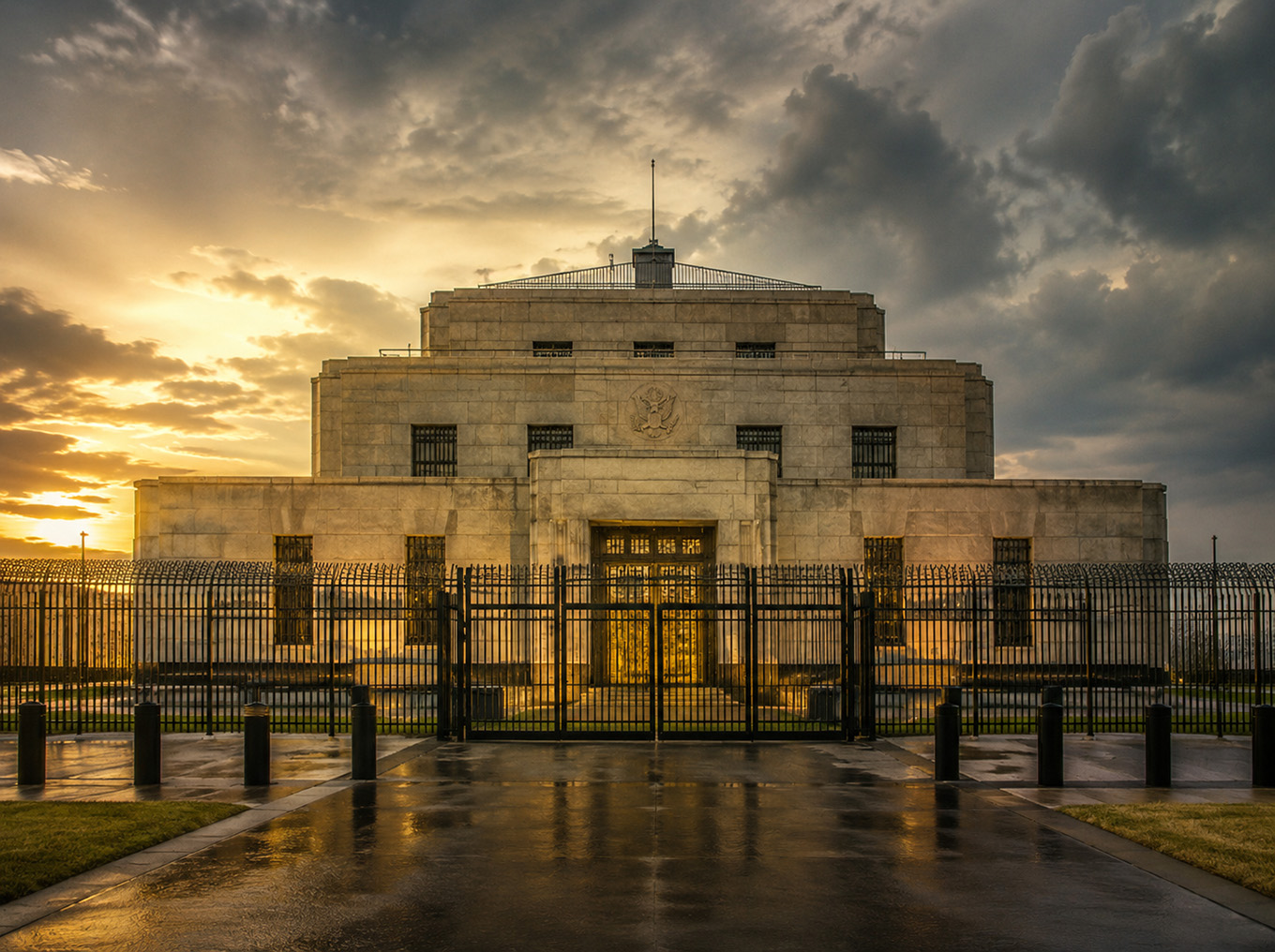
The Real Fort Knox Question Is No Longer Whether the Gold Exists
Fort Knox may still be full of gold. But according to Stefan Gleason, the real issue is whether America’s gold is audited, pure, liquid, unencumbered and ready to use in a crisis...
For generations, Fort Knox has been treated less like a government facility and more like a national myth. It sits in the American imagination as the ultimate symbol of financial strength: guarded, sealed, and assumed to be full of gold. That assumption has carried an extraordinary amount of weight. In a world built on confidence, few things matter more than the belief that America’s gold is exactly where Washington says it is.
But belief is not an audit.
Fort Knox's Missing Gold Audit
That was the central issue raised in Pinnacle Digest’s recent interview with Stefan Gleason, president and CEO of Money Metals Exchange and chairman of the Sound Money Defense League. Gleason is not merely commenting from the cheap seats. He runs a physical precious metals business, operates in the depository world, deals with vaulting, refining, premiums, storage logistics and the practical plumbing of the gold and silver market. He has also been involved in Washington discussions around precious metals infrastructure, including legislation intended to increase resiliency in America’s bullion market.
That background matters because the Fort Knox debate is usually treated as a conspiracy theory. One side asks whether the gold is there. The other side laughs and says, of course it is. Then the conversation ends.
It should not end there.
According to Gleason, the more serious question is not simply whether gold sits inside U.S. government vaults. The real question is whether America’s gold has been audited to modern standards, whether it is unencumbered, whether the chain of custody is intact, and whether it is liquid enough to be used in a crisis. Those are very different questions from the one usually asked on cable news.
Gleason argues that what Washington calls an audit has often been closer to a paperwork review of seals and compartment schedules than a full physical audit. In proper vaulting, that distinction matters. If a compartment is audited and sealed, the seal becomes part of the integrity of the process. If that seal is later broken, the contents need to be re-audited. Otherwise, the control system has been compromised.
That is basic custody protocol.
Not Pure Gold?
Gleason says the United States has not had a truly credible audit of its gold reserves in decades. He also points to a separate problem that may be even more important for investors: purity. According to Gleason, roughly 83% of U.S. gold reserves are not modern, high-purity bullion. Much of it is old coin-melt material, closer to 90% to 93% gold, from coins melted into bars decades ago.
To the average person, that may sound like a technical footnote. In the modern bullion market, it is not.
Gold is not just gold when it has to move through the institutional plumbing of the global financial system. Purity, assay, deliverability, refining capacity and good-delivery standards all matter. If Washington ever needed to use its gold in a serious market intervention, Gleason’s contention is that a large portion of those reserves would first need to be refined into a form acceptable to today’s market.
That is where the story becomes hard to ignore.
Gleason said U.S. refineries estimated that upgrading roughly 7,000 tons of non-pure U.S. gold could take about 30 years without disrupting the market. Thirty years is not a rounding error. It is a generational delay.
If that estimate is even directionally correct, then Fort Knox is not merely an audit story. It is an infrastructure story. It is a liquidity story. It is a national security story.
America's Gold Reserve Is Questionable
The public version of America’s gold reserve story is simple: the gold is there, so stop asking questions. The market version is more complicated: what exactly is there, who owns it, has any of it been pledged, swapped or leased, and can it be mobilized when it matters?
These questions are becoming more urgent because the rest of the world appears to be taking gold more seriously, not less. Central banks have been accumulating gold as confidence in paper promises weakens. Nations are repatriating metal. Asia is building physical demand. The dollar system, while still dominant, is no longer treated as untouchable by America’s rivals or even some of its allies.
In that environment, “trust us” is not a policy. It's a liability.
A serious audit would not be a field trip with cameras. It would not be a politician standing in front of stacked bars. It would mean physical inventory, modern assay, ownership verification, encumbrance review, chain-of-custody analysis and a clear assessment of whether the metal is usable under current market standards.
Fort Knox may still be full of gold.
But that is no longer the only question.
The real question is whether America’s most famous financial asset is ready for the world that is coming, or merely preserved for the world that has already passed.

Latest Insights
Recent Highlights from Our YouTube Channel
Comprehensive reviews of current market dynamics and the latest trends influencing the future of investments.