Why the Rich Secretly Love Inflation
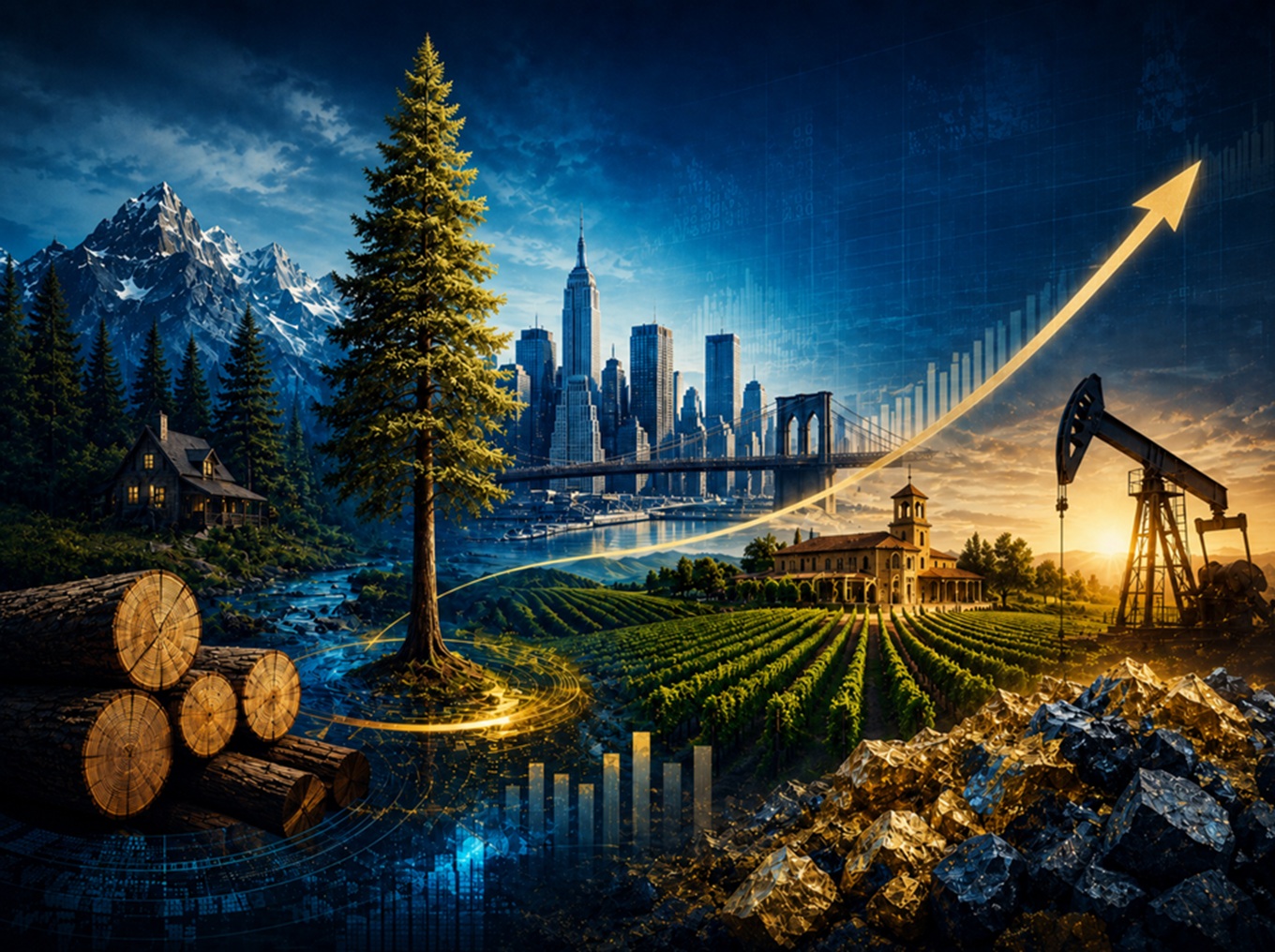
Inflation erodes the purchasing power of wages and cash, but it can reward people who own scarce, productive assets. From Washington timberland and New York real estate to California vineyards, oil fields and mineral deposits, history shows how hard assets have created extraordinary wealth. The lesson is not simply to own physical assets, but to own productive assets with scarcity, income potential and long-term demand.
Inflation is usually presented as an economic disease, but many see it as opportunity. If one knows the currency will devalue, they can buy assets that will appreciate, thereby preserving purchasing power. Buying later, what others can no longer afford.
Politicians promise to fight it. Central bankers insist price stability remains their priority. Government officials celebrate when inflation falls, yet pursue policies to maintain a 2% inflation target. Counterintuitive? Perhaps.
But inflation does not affect everyone equally.
For a family living paycheque to paycheque, inflation means higher grocery bills, rising rent, more expensive insurance and less money left at the end of the month.
For wealthy households that own businesses, stocks, real estate, timber, farmland, energy reserves and other scarce assets, inflation can make them even richer.
Inflation punishes savers while rewarding asset owners. It can reduce the purchasing power of wages and cash while increasing the nominal value of property, businesses and natural resources.
This is not a new phenomenon.
Long before the Federal Reserve existed, some of the largest fortunes in American history were built by acquiring things that could not be printed, rapidly reproduced or easily replaced.
Timberland in Washington.
Real estate in Manhattan.
Vineyards in California.
Oil beneath the ground.
Gold, silver and copper deposits.
Some names and assets change, but the game has not.
The Dollar Shrinks, the Asset Remains
The U.S. Bureau of Labor Statistics has tracked consumer prices since 1913. Its inflation calculator shows how dramatically the buying power of the dollar has declined across generations. A dollar held in cash for more than a century retained the number printed on it, but only a small fraction of its original purchasing power. By many calculations the U.S. Dollar has lost 99% of its value already.
A dollar does not become two dollars simply because time passes. It must be used to purchase assets if it is to grow.
A tree grows.
A productive vineyard produces another harvest.
A well-located apartment building collects another year of rent.
A mineral deposit becomes more valuable as high-grade resources become harder to find.
A business can raise prices, reinvest profits and expand production.
That is the fundamental difference between money and productive assets.
Cash is a claim on future goods. An asset is one of the goods.
Timber Made the Stimson Family Rich
More than a century ago, C.D. Stimson arrived in Seattle and made his fortune from the forests of the Pacific Northwest. The family’s timber wealth later helped finance significant real estate holdings and left a lasting mark on Seattle through hotels, theatres, parks, hospitals and cultural institutions.
The Stimson story began even earlier.
Thomas Douglas Stimson entered the lumber business in Michigan in the 1850s. After losing everything in an unsuccessful oil venture, he rebuilt his business by acquiring timberland, operating lumber camps and selling logs. By the 1880s, the family recognized that the best timber in Michigan was becoming scarcer and turned its attention west.
In 1889, the Stimsons established operations in Seattle and acquired timberlands in Washington, Oregon and California. More than a century later, Stimson Lumber remains a privately held, integrated forest-products company. I've been reading Dorothy Stimson Bullitt: An Uncommon Life which documents the rise of the family in Seattle and her life as a radio and television pioneer.
The asset was valuable for several reasons.
The land was finite.
The trees were renewable, but only slowly.
The timber could be harvested and sold.
The land itself could appreciate.
And as the population of the Pacific Northwest grew, demand increased for lumber, housing, commercial buildings and infrastructure.
Frederick Weyerhaeuser made an even larger version of the same bet. In 1900, Weyerhaeuser and his partners bought 900,000 acres of Washington timberland for approximately $6 per acre. By 1903, the company owned more than 1.5 million acres in Washington, and it eventually acquired millions more.
They were not merely buying wood.
They were acquiring land, biological growth, future lumber production and an asset that could be held across multiple monetary regimes.
A paper dollar could be created instantly. A mature Douglas fir could not.
John Jacob Astor Bought the Growth of New York
John Jacob Astor initially made his fortune in the fur trade, but his most enduring wealth came from Manhattan real estate.
Astor began purchasing land in New York in 1799. By the 1830s, he saw that the city was expanding northward and began accumulating and developing large tracts of Manhattan property. The Astor family would remain one of the world’s wealthiest families through its enormous portfolio of deeds, leases, buildings, mortgages and rent-producing land.
Astor understood something that remains true today.
The most valuable real estate is not simply land. It is land positioned in the path of human activity.
As New York’s population grew, the supply of Manhattan did not.
More residents needed homes. More businesses needed storefronts. More employers needed offices. More commerce flowed through the city.
The demand surrounding Astor’s properties expanded, but the island did not.
This is why exceptional real estate can outpace inflation over long periods. Its value is not determined solely by the cost of bricks, timber and labour. It also reflects location, scarcity, zoning, infrastructure, population growth and proximity to economic activity.
Astor did not need to predict the exact annual inflation rate. All he knew was that there was a finite amount of space and real estate in New York.
He needed to understand that productive human activity would continue converging on a limited amount of land.
California Vineyards Turned Dirt Into Global Brands
California’s great wine fortunes were also built on the union of scarce land and productive enterprise. The same theme plays out, finite resources, unlimited and expanding money supply, driving the value of these natural resources higher.
In the early twentieth century, Napa Valley was not yet the global luxury destination it is today. The region endured collapsing grape prices, phylloxera and Prohibition. Vineyards were abandoned, wineries closed and the industry nearly disappeared.
Following the repeal of Prohibition, a small group of families began rebuilding. The Mondavis acquired Charles Krug Winery. Georges de Latour re-established Beaulieu Vineyard. Other pioneers restored vineyards and proved that Napa could produce wines competitive with the best in Europe.
In 1966, Robert Mondavi opened the first major new Napa winery since Prohibition. He placed the To Kalon Vineyard at the heart of his operation because he understood that exceptional wine begins with exceptional land.
The vineyard was not valuable merely because it consisted of acreage.
Its soils, drainage, climate, location, vines and reputation could not be easily reproduced elsewhere. Again, money is not unique or novel, these tangible assets were and still are today.
Mondavi combined that physical scarcity with branding, distribution, winemaking expertise and relentless promotion. In doing so, he helped transform Napa Valley from an agricultural region into one of the world’s most valuable wine-producing areas.
The Judgment of Paris in 1976 accelerated that transformation when California wines defeated highly regarded French wines in a blind tasting. Napa’s reputation changed almost overnight, and the number of wineries eventually expanded from a few dozen to several hundred.
The value was created in layers.
There was the land. There were the vines. There was the annual grape harvest. There was the wine. There was the brand.
And there was the growing global prestige attached to the words “Napa Valley.”
A vineyard, however, is also a useful warning.
Not every parcel of agricultural land becomes To Kalon. Grapes can suffer from disease, drought, fire, changing consumer tastes and poor management. A vineyard without a market, water, skilled operators or a respected brand may fail to keep pace with inflation.
Scarcity helps, but productivity and quality still matter.
J. Paul Getty Bought Oil in the Ground
J. Paul Getty became one of the richest people in the world by controlling another resource that could not be created by monetary decree.
Oil.
Getty learned the industry in the Oklahoma oil fields and made his first million while still in his twenties. During the 1930s, he concluded that some publicly traded oil companies were selling for less than the underlying value of their reserves, equipment and operating assets.
Rather than paying full price for oil properties, he bought shares that gave him indirect ownership of oil in the ground at a steep discount.
His greatest gamble came in the late 1940s, when he negotiated a 30-year oil concession in the Neutral Zone between Saudi Arabia and Kuwait. Oil had not yet been discovered there, and the exploration costs were enormous.
The gamble succeeded.
The concession helped turn Getty Oil into an integrated global energy company involved in exploration, production, transportation, refining and distribution. In 1957, *Fortune* named Getty the richest man in the world.
Getty was not simply betting that oil prices would rise.
He was acquiring control over an essential resource that powered automobiles, aviation, shipping, manufacturing, chemicals and modern warfare.
He owned something the entire industrial economy needed.
Inflation could increase the number of dollars chasing energy. It could not instantly create another giant oil field.
George Hearst Owned the Metal Beneath the Land
George Hearst built another extraordinary fortune by acquiring interests in mineral deposits.
Hearst was connected to some of the most important mining properties in American history, including the Comstock Lode in Nevada, the Ontario silver mine in Utah, the Homestake gold mine in South Dakota and the Anaconda copper mine in Montana.
At Homestake, Hearst and his partners consolidated claims over an ore-rich deposit that became one of America’s most famous and enduring gold mines. By the time Hearst died in 1891, his fortune was estimated at approximately $18 million to $19 million, an enormous sum for the period.
The mining wealth later helped finance the *San Francisco Examiner*, laying part of the foundation for the Hearst publishing empire.
This is how hard-asset fortunes often compound.
A productive resource creates cash flow. The cash flow purchases another asset. That asset finances a business.
The business purchases political, cultural or commercial influence.
The original mine eventually closes, but the wealth created from it continues moving through generations.
The Modern Wealth Boom Follows the Same Pattern
The same dynamic is visible today.
UBS reported that global personal wealth rose by more than 10% in 2025, its fastest pace in years. Nearly one million people became U.S. dollar millionaires, an increase of more than 2,600 per day. One day, in the not too distant future, everyone will be a millionaire. A million dollars will not be a very large amount of money.
Most of these people did not become millionaires because one year of wages suddenly made them rich.
They crossed the threshold because the value of assets they already owned increased.
Homes appreciated. Stocks rose. Businesses received higher valuations. Currencies moved. Private companies expanded. Farmland continued climbing.
U.S. farm real estate reached an average value of $4,350 per acre in 2025, up 4.3% from the previous year and 1.9% after inflation. Farm real estate accounted for approximately $3.67 trillion, or more than 83% of total U.S. farm assets.
The Federal Reserve has also noted that inflation-adjusted farmland prices continued rising from already elevated levels in 2025, supported partly by limited available inventory.
Once again, the central advantage is ownership.
The farmer who owns the land participates in its appreciation. The farmer who rents it pays the higher price. The homeowner builds equity.
The renter absorbs rising housing costs. The business owner may raise prices.
The employee must wait for the next salary negotiation.
Not Everything Outpaces Inflation
The lesson is not that every physical object is a good investment.
Cars are physical assets, but most depreciate.
Buildings can become obsolete.
Farmland can be purchased at an unsustainable price.
Forests can burn.
Oil wells can run dry.
Mines can fail to produce an economic deposit.
Vineyards can lose customers.
Real estate can remain vacant.
Even productive assets can collapse when buyers use too much leverage. The U.S. farmland boom of the 1920s, for example, was amplified by easy credit and followed by falling land prices and widespread bank failures when the underlying assumptions deteriorated.
Hard assets are not magic. Price matters. Debt matters. Cash flow matters. Location matters.
Management matters.
The best inflation-resistant assets tend to share several qualities. They are scarce, difficult to reproduce, useful to other people, capable of generating income and owned with financing that can survive difficult periods.
Inflation Is Not Equal Opportunity
A wealthy investor can hold cash temporarily, borrow at attractive rates, purchase assets during downturns and wait years for the thesis to unfold.
A working family may need every dollar for food, shelter, transportation and childcare.
That is why inflation increases inequality even when it does not appear especially dramatic in a monthly government report.
The person with no assets experiences higher costs.
The person with productive assets may experience higher rents, revenues, land values and business valuations.
The saver owns yesterday’s dollars.
The asset owner owns part of tomorrow’s economy.
That does not mean the wealthy want uncontrolled inflation. Runaway inflation destroys planning, raises financing costs, destabilizes businesses and can bring down entire political systems.
What asset owners often benefit from is the slower, persistent erosion of money combined with rising nominal asset values.
Two percent here.
Three percent there.
Occasionally much more.
Compounded across decades, the effect is enormous.
The Stimson family owned the trees.
Astor owned the land beneath a growing city.
Mondavi controlled exceptional vineyard acreage and built a global brand around it.
Getty owned the oil.
Hearst owned the ore.
Their assets were different, but the strategy was remarkably similar.
They accumulated scarce, productive resources and allowed population growth, industrial expansion, human ingenuity and the declining value of money to work in their favour.
The world has changed dramatically since those fortunes were built.
The game has not.

Latest Insights
Recent Highlights from Our YouTube Channel
Comprehensive reviews of current market dynamics and the latest trends influencing the future of investments.