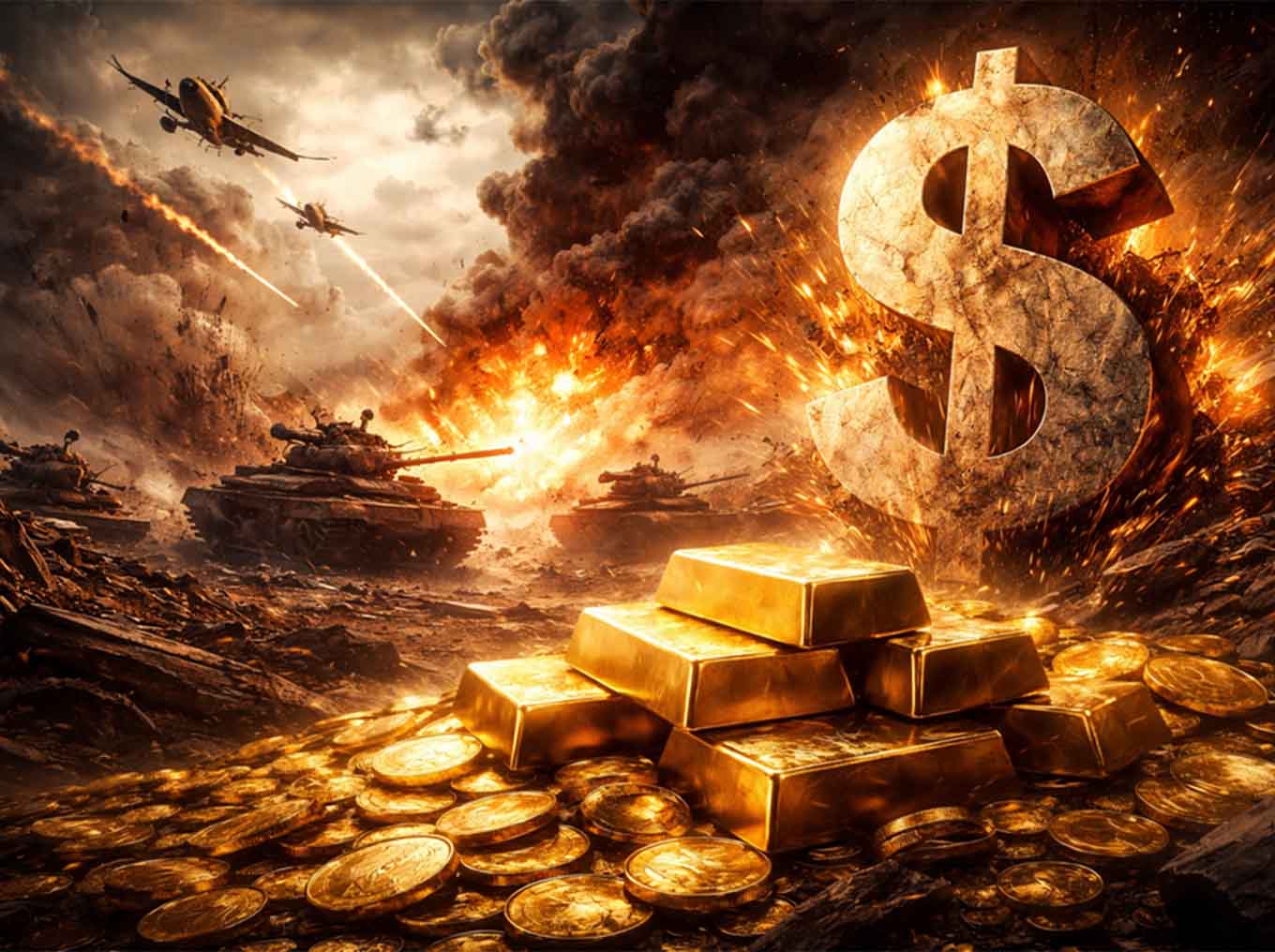
Mark Faber’s Warning to Investors: War, Currency Decay, and Why Losing Less May Matter More Than Winning Big
In this interview, Marc Faber explains why war, debt, and money printing are becoming one story for investors. He argues that precious metals still matter, paper currencies keep losing value, and the next cycle may reward investors who focus more on protecting capital than chasing returns.
There are moments in markets when the noise becomes deafening.
Oil spikes. Headlines turn apocalyptic. Politicians posture. Bond yields jump. Gold rips higher. Equity investors start asking the same question they always ask during moments of stress: What now?
In a recent podcast, Alexander Smith sat down with legendary contrarian investor Dr. Marc Faber, one theme stood above the rest. This was not a discussion about chasing the next hot trade. It was not about getting rich quick from a geopolitical headline. It was something much more useful, and much more difficult for many investors to accept.
It was about survival.
Faber’s message was simple, even if the implications were not: in an era defined by war risk, monetary excess, and declining confidence in institutions, the winners may not be the people who make the most. They may be the people who lose the least.
That idea deserves serious attention from investors today, especially those navigating resource equities, broad market exposure, and self directed portfolios.
This conversation can be distilled into three core ideas.
1. War does not just Move Oil. It Exposes the Fragility in Economies
Most investors view war through the narrow lens of energy prices.
If conflict expands in the Middle East, oil rises. If oil rises, inflation fears return. If inflation fears return, central banks stay trapped. That is the basic chain reaction, and it matters. But Faber’s point was broader. War does not simply create a commodity spike. It puts pressure on the entire financial system.
Higher energy costs do not stay confined to the pump. They move through transportation, food, manufacturing, logistics, shipping, and consumer sentiment. They hit margins. They strain households. They weaken already fragile economic growth. They also complicate the bond market, which is where the real story may lie.
Washington needs lower financing costs. Instead, geopolitical instability can produce the opposite effect in the short term. That is a problem when debt service is already swelling and deficits remain enormous. Investors often focus on whether stocks will recover from a selloff. But the more important question may be whether the financial plumbing underneath the market can remain stable if war pushes costs higher while growth weakens.
This is where Faber’s perspective becomes especially relevant for equity investors.
He is not arguing that every war automatically leads to a crash. He is arguing that war arrives at a time when the system is already overextended. Asset prices have spent years floating on easy money, central bank support, and the assumption that policymakers will always step in. But when inflationary pressure collides with slowing growth, the choices become uglier. Print more and debase the currency further. Tighten policy and risk breaking asset markets. Stagflation is never a good outcome and probably the second worst to outright deflation.
For resource investors, however, this shifting environment matters in a different way. War reminds the world that energy, metals, supply chains, shipping lanes, and national security are deeply connected. Commodities are no longer a side show. They are central to the global power struggle. Oil, gold, copper, uranium, silver, and strategic minerals all become more important when the world becomes more unstable.
That does not mean every resource stock is automatically a buy. It means the sector gains relevance when investors rediscover that the physical world still matters.
For years, capital was rewarded for hiding in passive indexes, long duration growth stocks, and narratives untethered from scarcity. Periods like this force capital to reprice risk. They also force investors to remember that the world runs on molecules, metals, and money, not just software and sentiment.
2. The Real Threat is Not One Bad Headline. It is the long decay of paper money
Faber has spent decades warning about debt expansion, monetary distortion, and the illusion of stability created by central banks. His framework remains straightforward: paper currencies always lose purchasing power over time, because when societies face pain, politicians choose printing over discipline.
That is the real issue.
Not whether the dollar rallies in a panic for a few weeks. Not whether one currency looks better than another on a chart. But whether the underlying purchasing power of money continues to erode across years and decades.
Faber’s argument is not that the US dollar collapses tomorrow morning. It is that all fiat systems eventually drift in the same direction. Some just decline faster than others. In moments of panic, capital still rushes into the dollar because it remains the deepest and most liquid safe haven in a crisis. But that should not be confused with long term monetary health.
This distinction matters enormously for self directed investors.
Many people are still thinking in nominal terms. They see a portfolio rise, a house rise, or an index make new highs, and they assume wealth is being created. Sometimes it is. But often, what they are really seeing is the money unit being diluted while asset prices drift higher. Sometimes they outpace inflation, sometimes they do not.
That is why Faber continues to prefer precious metals as a store of value. Not because gold is perfect. Not because it never corrects. And not because miners cannot be volatile. But because gold sits outside the promises of politicians and central bankers. It cannot be printed. It cannot be voted into existence. It does not depend on trust in a government balance sheet.
His comments on ownership are especially important. Even after a major move in gold, exposure remains tiny across the general investing public and among professional managers. Most portfolios still treat precious metals as an afterthought. That is remarkable when one considers central banks themselves have been accumulating gold more aggressively over the last several years.
In other words, the public still largely trusts the system that policymakers themselves appear to be hedging against.
That disconnect matters.
Marc Faber's message is not to abandon productive businesses or sit frozen in fear. It is to understand the difference between an asset that benefits from currency debasement and an asset that merely rises with liquidity. In a serious monetary reset, those are not always the same thing. As he explains, sometimes even equities can go down when central banks print money.
For resource investors, it reinforces why gold, silver, and hard asset producers may remain strategically important even after strong runs. The bull market may not be linear. It may be violent, frustrating, and full of drawdowns. But if the underlying currency problem remains unsolved, the long term case does not disappear because of one correction.
3. In the Next Cycle, Protecting Capital may be more Important than Maximizing Returns
This may have been the most important takeaway from the entire discussion.
Faber did not come across as a man trying to predict every tick in the market. He came across as someone warning that the game itself is changing.
For decades, investors have been conditioned to believe that weakness is temporary, central bank rescue is inevitable, and broad asset prices always recover higher with time. That mindset worked extraordinarily well during an era of expanding liquidity, globalization, falling rates, and rising multiples. But what if the next era looks different?
What if the great challenge of the next decade is not simply finding the fastest horse, but avoiding the deepest drawdown?
That changes behavior.
It forces investors to think more carefully about valuation, balance sheets, liquidity, jurisdiction, and concentration risk. It puts a higher premium on real assets, cash flow, and staying power. It also makes diversification more than a cliché.
This is especially relevant in the resource space, where upside can be explosive but volatility can be brutal. Investors who survive long enough to catch great cycles are usually not the ones who chase every story. They are the ones who manage risk, remain selective, and understand that preserving capital gives them the ability to act when real opportunity appears.
Faber’s thinking also offers a useful correction to the always bullish culture of financial media. The market does not owe anyone a smooth path higher. Entire sectors can stagnate for years. Some assets never recover. Some manias permanently destroy capital. The idea that prices should rise forever is not a law of nature. It is a habit of thought built during an unusual period in history.
That period may be ending.
If so, then the investor mindset must change with it.
That does not mean becoming permanently bearish. It means becoming more realistic. It means recognizing that cycles still exist, that policy makers are trapped, that inflation is more complex than a single CPI print, and that preserving purchasing power may matter more than beating an index by a few points in any given year.
For many self directed investors, that may be the hardest lesson of all. Discipline is less exciting than speculation. Patience is less entertaining than prediction. But over a full cycle, those traits tend to matter more.
Marc Faber’s warning is not really about fear. It is about humility.
War can widen. Debt can compound. currencies can weaken. Asset bubbles can deflate. Governments can choose expediency over discipline again and again. Investors cannot control any of that.
But they can control how exposed they are to delusion.
In a world still obsessed with the next winner, Faber is asking a better question: what if the smartest investor in the next cycle is simply the one who protects enough capital to still be standing when the real bargains finally appear?
That may not be exciting.
But it may prove incredibly profitable.

Latest Insights
Recent Highlights from Our YouTube Channel
Comprehensive reviews of current market dynamics and the latest trends influencing the future of investments.