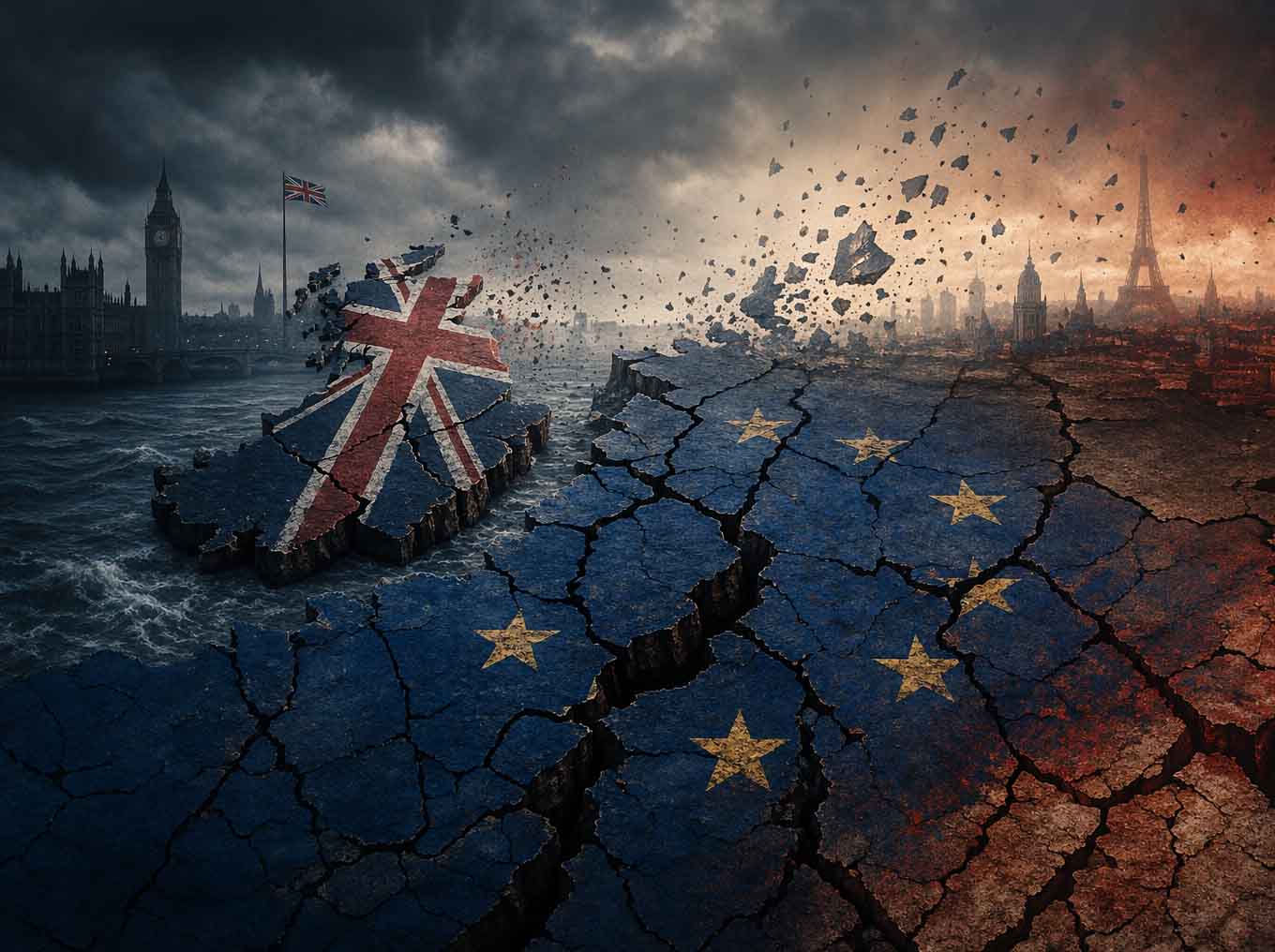
The Collapse Before the Collapse: Preparing for Societal Fracturing
David Betz warns that collapse does not begin with tanks in the streets. It begins much earlier, with falling trust, fractured identity, weakened institutions, and a society that still appears functional on the surface while growing more brittle underneath.
There is a dangerous habit in wealthy, advanced societies: they assume collapse will never happen or that it will announce itself.
People imagine the end of order as a single dramatic event. They picture tanks, barricades, flames, and formal declarations. They expect the breakdown of a nation to arrive with such force and clarity that no one could possibly miss it.
But real decline is often quieter than that. It begins in places most people do not track. It begins in mood. In trust. In legitimacy. In the slow erosion of the shared assumptions that make millions of strangers feel like they belong to the same country.
That is what makes David Betz’s argument so unsettling.
He recently joined Aaron on the Pod and his warning is not simply that internal conflict could emerge in parts of the West. It is that the preconditions for serious fracture may already be visible long before open conflict takes shape. In his view, societies do not fail all at once. They weaken in advance, beneath the rituals of normal life, while much of the public continues to act as though tomorrow will look more or less like today.
As Betz puts it:
“Societies do not collapse in one obvious moment. They begin earlier with falling trust, fractured identity, parallel communities and institutions that no longer feel legitimate.”
That is the heart of the matter.
For investors, this is more than political philosophy. Markets can absorb a remarkable amount of tension while the deeper structure of society decays underneath. Equities can rise. Bond markets can function. Consumption can limp along. Politicians can still speak the language of stability. But if the foundations of cohesion are weakening, then the apparent calm may be more fragile than it looks.
The real danger is not always the headline event. The real danger is the long invisible lead up to it. If you missed, what is becoming one of the most important discussions of the year, its time to enjoy the conversation below.
The Warning Signs of Collapse Begin With Falling Trust
A stable country does not require universal agreement. It requires something simpler and more essential: enough trust to keep disagreement from becoming permanent hostility.
Once that trust starts to fade, the damage spreads farther than most people realize. Elections begin to feel hollow. Institutions begin to look partisan. Courts are treated with suspicion. Media is seen as ideological. Bureaucracies are viewed as insulated from consequence. The public starts to suspect that the people who manage the country no longer believe in the same country as the people living in it.
At first, this presents as cynicism. Then it hardens into estrangement. In time, it becomes a crisis of legitimacy.
That transition matters because legitimacy is one of the few forms of capital a society cannot print, borrow, or import. A government can finance a deficit. It can subsidize fuel. It can expand welfare. It can issue debt. But when the public no longer believes the system is fair, representative, or worth preserving, policy tools begin to lose their power.
This is where political decay becomes a macro story.
A high trust society can withstand inflation, energy shocks, ugly elections, migration pressure, and even periods of stagnation because citizens still grant the system a measure of moral authority. A low trust society faces the same pressures without that cushion. Every mistake becomes betrayal. Every compromise becomes surrender. Every crisis becomes further evidence that the old order is exhausted.
That is not just a cultural problem. It is an investment problem.
Why Political Legitimacy Is a Major Macro Risk
Investors tend to focus on variables that fit neatly into charts. GDP growth. Inflation. deficits. Rates. Employment. Housing. Credit spreads.
But social legitimacy may prove just as important in the decade ahead.
A country that loses belief in its institutions becomes harder to govern and more expensive to hold together. Policing costs rise. Insurance becomes more complex. infrastructure maintenance becomes politicized. capital seeks safer jurisdictions. productive people disengage or leave. Businesses demand a larger risk premium before committing long term money. The state spends more energy containing pressure and less energy building resilience.
A nation can remain functional on paper while becoming brittle in practice.
That brittleness is often invisible until an external shock arrives. Then suddenly, what once looked like a normal political disagreement reveals itself as a deeper fracture running through the society.
This is one reason the most important question is no longer simply whether a country is growing. It is whether that country still possesses enough cohesion to manage stress without turning on itself.
Mass Migration, Identity, and the Pressure on Social Cohesion
One of the most controversial parts of Betz’s argument centers on migration and identity. Whatever view one takes of his conclusions, the broader structural point deserves attention: demographic change is easiest to absorb when a society is confident in itself.
When a country feels strong, cohesive, and optimistic, immigration can be folded into an existing national story. A shared framework exists. Assimilation feels possible. The culture assumes it has enough gravity to integrate newcomers into a larger whole.
But when confidence is already weak, demographic change is interpreted differently. It is no longer seen simply through the lens of labor, growth, or pluralism. It starts to be felt as symbolic. As displacement. As evidence that the country’s leaders are either detached from the lived reality of the public or indifferent to it.
In that environment, even ordinary tensions become loaded with existential meaning.
Neighborhoods change and the shift feels civilizational. Public policy changes and it feels like surrender. Economic competition merges with questions of identity. Communities begin to think of themselves less as participants in one shared project and more as rival populations occupying the same territory under one administrative roof.
That is the kind of drift that should concern anyone trying to understand the long term trajectory of Western societies. Not because conflict is automatic, but because cohesion, once weakened, is extremely difficult to rebuild.
Modern Conflict Would Be Fragmented, Not Formal
One of Betz’s most effective insights is that any serious internal conflict in a modern Western country would not resemble the wars people instinctively imagine.
As he says:
“It’s not going to look like the American Civil War. It’s going to be much messier than that.”
That line matters because it strips away the false mental picture many people still carry. They expect clear battle lines, obvious factions, formal armies, and recognizable fronts. But in advanced urban societies, disorder would likely be much more diffuse.
It would be local. intermittent. decentralized. It would emerge through sabotage, disruption, intimidation, self organizing movements, and the gradual breakdown of the assumption that the law is the only game in town.
The conflict, in other words, would not need to look cinematic to become economically devastating.
Infrastructure Vulnerability Is the Soft Underbelly of Modern Society
For investors, one of the most important parts of Betz’s framework is his emphasis on infrastructure.
Modern civilization feels durable because it is technologically sophisticated. In reality, its very sophistication makes it vulnerable. Urban life depends on tightly linked systems: electricity, fuel, transport, digital payments, communications, water treatment, logistics corridors, distribution hubs, and data networks. These systems appear sturdy because most people assume no one would deliberately target them and because the public has grown accustomed to their uninterrupted function.
That assumption may not hold forever.
A society under strain does not require conventional armies to create chaos. It only requires enough actors willing to create friction in the places where daily life is most dependent on smooth operation. Disrupt movement. Interrupt supply. Damage key nodes. Force delays. Raise uncertainty. Multiply costs.
In highly integrated economies, even modest disruption can travel surprisingly far.
The frightening part is not just the vulnerability itself. It is how unprotected parts of ordinary life may be against low level acts of disruption. Modern infrastructure was built for normally functioning societies. It was not built for conditions in which growing numbers of people see the system as illegitimate, hostile, or expendable.
That is where political breakdown becomes material.
Electricity disruptions affect industry. Transport disruptions affect freight. Social disorder affects insurance. Security concerns affect investment. Infrastructure fragility affects everything from municipal finance to airport reliability to the cost structure of entire supply chains.
War, Energy Shocks, and External Pressure Can Accelerate Internal Breakdown
Internal disorder rarely develops in isolation. It is often intensified by external strain.
War on a region’s periphery. expensive energy. weakening growth. persistent deficits. rising living costs. political estrangement from allies. all of these pressures feed the same basic perception: the state is losing its ability to preserve stability.
Europe’s energy predicament is a vivid example. For years, the continent benefited from assumptions that now look fragile: cheap inputs, manageable geopolitical risk, abundant credit, and an international system stable enough to cushion policy mistakes. That environment helped hide structural weaknesses. It made political promises easier to finance and social tensions easier to suppress.
But when energy becomes more costly, growth becomes weaker, and the fiscal room to smooth over public anger begins to vanish, the underlying cracks widen. With the war in Iran and the blockade of the Strait of Hormuz, energy dependent countries are about to find out how wide those cracks are.
That is when legitimacy matters most. A society with trust can endure sacrifice. A society without trust interprets sacrifice as exploitation.
And when economic pain lands on younger households, working families, small businesses, and communities already squeezed by inflation and declining opportunity, financial stress fuses with cultural and political grievance. That combination is far more dangerous than recession alone.
The Financial World Often Notices Social Decay Too Late
Markets are excellent at pricing what has already become obvious. They are less reliable when the threat is slow, cultural, and politically taboo.
That is why investors should pay attention not just to macro indicators but to the quieter signs of social fragmentation: distrust in institutions, the rise of anti status quo movements, the formation of parallel communities, the spread of informal networks, and the growing belief that voting or participation no longer matters.
These are not just political curiosities. They are early warning signals.
If the next era of volatility is driven not only by inflation or recession but by legitimacy crisis, then the winning framework may not come from economics alone. It may come from history, sociology, and political risk analysis.
Gold, energy security, defense, food resilience, domestic production, and asset jurisdiction all start to look different when viewed through that lens. The question becomes less about maximizing returns in a stable world and more about preserving optionality in a less stable one.
The Real Risk Is Normalcy Bias
Perhaps the most chilling aspect of Betz’s thesis is how simple it is.
People assume continuity.
They assume the lights will stay on because they usually do. They assume institutions will endure because they always have. They assume social peace is a default setting rather than a fragile achievement maintained by trust, restraint, legitimacy, and shared identity.
That instinct has a name: normalcy bias. It is the tendency to believe that because disaster has not yet fully arrived, it probably will not.
But history punishes that assumption again and again.
By the time the average person recognizes that a society is in serious trouble, many of the preconditions were already in place. Trust had already weakened. Cohesion had already thinned. Legitimacy had already been squandered. The visible crisis was simply the moment those hidden conditions became impossible to ignore.
Betz captures that urgency in one of the sharpest lines from the conversation:
“The tinder is already there. What’s waiting is the spark.”
That is why the most dangerous phase may be the one we are least trained to recognize. Not open conflict itself, but the period just before it, when institutions still function, markets still trade, daily routines still continue, and yet the society beneath them is growing more brittle by the month.
The collapse before the collapse is not dramatic enough for most people to notice. That is precisely what makes it dangerous.
It does not begin with a bang.
It begins with a loss of faith.
It begins when a country still works, but fewer and fewer people believe it deserves to.
And by the time that shift is obvious to everyone, the real turning point is already behind us.
The visible crisis comes later. The fracture comes first.

Latest Insights
Recent Highlights from Our YouTube Channel
Comprehensive reviews of current market dynamics and the latest trends influencing the future of investments.