
Silver Is Getting Too Small to Contain the World’s Demand
Silver isn’t just rising in price; it’s colliding with the limits of its own market structure. With silver trading above $100, a small, fragile market is being asked to absorb massive industrial demand, investor fear, and a breakdown in the hedging systems that normally keep things stable. This article explains why silver’s size, not speculation, is the real reason it’s becoming dangerous, and explosive.
At some point in every commodity bull market, the chart stops being the story. Not because price doesn’t matter, but because the market’s plumbing matters more than the quote on the screen.
That’s where silver is right now.
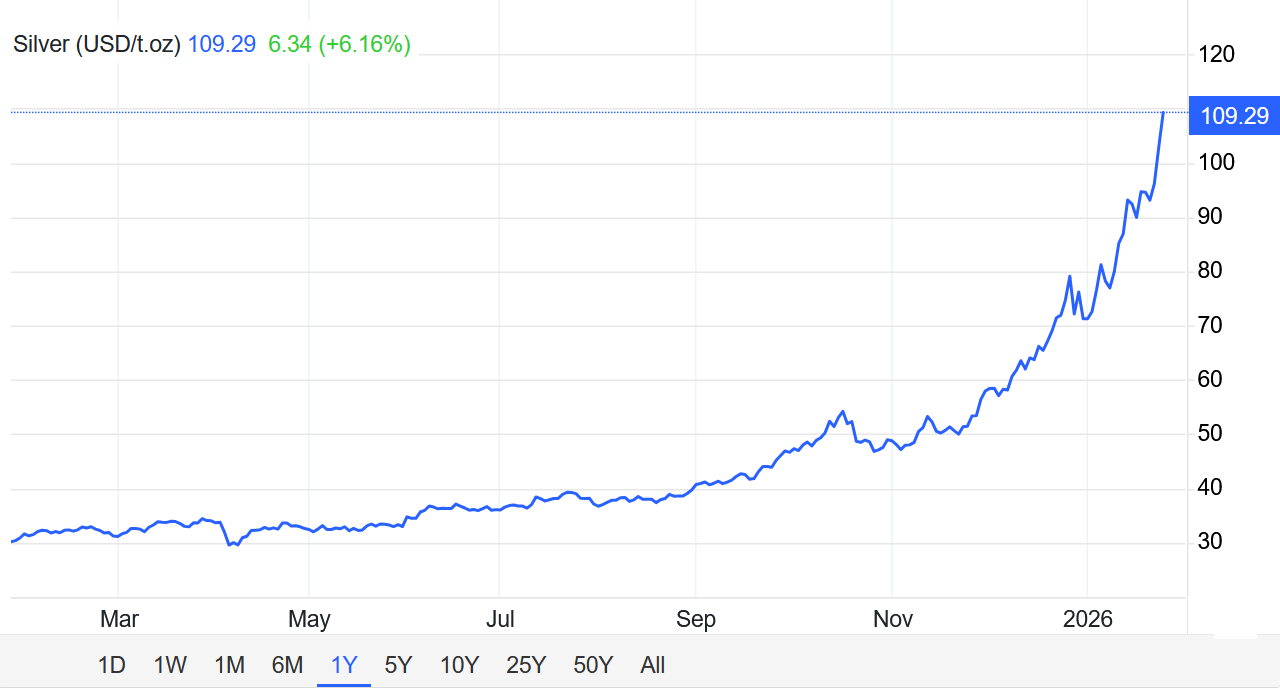
This morning, silver printed around $109/oz, a level that sounds like a typo until you realize what’s really moving it: not hype, not memes, not a sudden global love for jewelry. But the underlying structure. Silver is the rare market where a relatively small shift in flows, a spike in industrial buyers, retail investment demand surge, combined with a few nervous wholesalers pulling back, and it can create violent outcomes.
So, when the market is that small, it doesn’t take much to make it misbehave. As this historic rally continues, led by retail investment demand in China, let's take a look at how silver moves hands. On Friday, my local coin shop stopped buying silver. Keep reading to find out why.
Silver Market is Tiny but has Giant Job
Silver has a big reputation, from real money and being known as the “poor man’s gold.” But that reputation hides the modern reality: silver is a crucial industrial input in a world that’s trying to electrify everything.
Now put that next to an uncomfortable fact: the silver market, especially tradable, deliverable silver, isn’t built to absorb large, persistent demand shocks. It’s not like crude oil, where the market is deep and liquid and inventory systems are massive. Silver is more like an essential component that global manufacturing quietly depends on… until it becomes scarce and everybody notices at once.
That’s the key: silver can go from “available” to “unavailable” very fast. Here is why “small” matters more than “bullish”.
Most people think markets move because buyers outnumber sellers. In silver, that’s not wrong, but it’s incomplete.
In a small market, the real danger is when risk managers get spooked.
Here’s the chain most people never see:
Your local coin shop doesn’t want to warehouse mountains of silver.
They buy from you and quickly sell it to a regional wholesaler, a refiner, or a national bullion desk.
Those larger buyers handle big volume, but they also run on tight risk controls.
When that wholesale layer steps back, when the phones stop answering bids, local shops can’t just “take the other side.” They freeze, because they’ve lost their exit.
That’s when a market starts acting less like a marketplace and more like a traffic jam.
Hedging: the invisible stabilizer (until it fails)
So why would a wholesaler stop buying silver even when demand is obviously strong?
Because wholesalers aren’t trying to “be right” about price. They’re trying not to get destroyed by volatility.
They normally protect themselves with something called hedging, which is basically price insurance:
- They buy physical silver.
- At the same time, they lock in a sell price in the paper market (usually via futures/forwards linked to major pricing venues like COMEX or LBMA).
- If silver drops tomorrow, their locked-in paper position offsets the loss on the physical.
- In a healthy market, this is boring. It’s how the machine stays stable.
- But in a stressed market, things can get very exciting, very fast.
Many also have reason to believe that the Comex's vaults are low if not almost entirely drained. If delivery of the physical metal is in question, the hedging market becomes a game filled with fear.
The moment it breaks: When paper no longer matches reality
Hedging only works if the paper market behaves like a reliable mirror of the physical market.
But when the system is under strain, you start seeing some mix of:
- spreads blowing out (the difference between “paper price” and “real physical” widens), (TRY BUYING A PHYSICAL OUNCE OF SILVER RIGHT NOW, MOST ARE QUOTING NORTH OF $120 PER OUNCE)
- margin requirements spiking (cost to hold hedges jumps),
- and, most important, delivery risk rising (confidence drops that contracts represent metal that can actually be sourced and moved when needed).
Once delivery risk rises, paper hedges begin to feel like an insurance policy written by a company that might not pay.
So wholesalers do the rational thing: they stop quoting bids. They’d rather miss a move than be forced into a position where the “hedge” doesn’t hedge.
That’s not bearish. That’s the market breaking down.
Silver at $109 isn’t the headline. The headline is: the market is repricing trust.
When you see silver trading at these levels, don’t only think “silver is up.”
Think:
- What happens when industrial buyers and investors both want the same thing?
- What happens when the wholesale layer can’t confidently hedge inventory?
- What happens when “paper” and “physical” stop moving as one?
In those moments, silver doesn’t just trend, it jumps. It gaps, it squeezes, it dislocates. And it does it because the market is small enough that confidence becomes a form of inventory.
That’s why a day can arrive, suddenly, where a shop says:
“We’re not buying.”
I experienced this at multiple coin shops in the PNW on Friday afternoon.
Not because silver is unwanted. Because it’s too risky to intermediate.
The Structural Deficit Problem: Silver has been Running Hot
It’s also worth understanding the backdrop: silver hasn’t been swimming in surplus. The Silver Institute has been tracking repeated deficits in recent years, including a large deficit cited in its survey work.
According to a Mining Weekly article, by Darren Parker, Silver surges as supply deficits, industrial demand drive prices higher – Peel Hunt,
"Peel Hunt said on January 20 that the metal remained structurally undersupplied, with global mine production growth remaining weak. The firm estimated 2025 mine output increased by about 2% to 830-million ounces, marking the fifth consecutive year of deficits."
Deficits don’t automatically cause immediate shortages, markets can draw from inventories, recycling can rise, investment demand can cool. But a persistent deficit environment does something important:
- It makes the system less resilient.
So when a new wave of demand hits, industrial, investment, safe haven, whatever the catalyst, there’s less slack. Less buffer. Less “extra” to smooth volatility.
And that’s when the hedging layer becomes the deciding factor.
What “delivery risk” Actually Means in the Real World
Delivery risk sounds abstract until you translate it into plain consequences:
- A wholesaler buys your silver today.
- They hedge it with a paper position.
- Then later, when they need to replace that metal or deliver it onward, the physical supply chain is tight or delayed.
- If the physical market is stressed, the wholesaler’s problem is not “price went against me.” It’s “I can’t get the metal when I need it.”
In other words: they can’t complete the trade.
That’s why “delivery risk rising” is a big deal. It can turn normal business into a potential loss event even in a roaring bull market.
And when these stresses pop up, they tend to cluster with broader safe-haven surges. That’s exactly what today’s mainstream headlines are capturing: precious metals ripping to record territory as fear rises.
The Real Silver Story: a Market Too Small for its New Identity
Silver is trying to be two things at once:
- A monetary metal (a fear trade, a currency hedge, a credibility asset)
- An industrial lifeline (solar, electronics, electrification, manufacturing)
Most commodities only have one master. Silver has two.
That’s why its market structure matters so much.
When the world treats silver like an industrial input, it behaves like a commodity. When the world treats it like money, it behaves like a vote against the system. When both happen at the same time, silver becomes something else entirely:
A small market with a giant job, and not enough shock absorbers.
Why this should matter to all investors. If you’re a retail investor reading mainstream coverage, you’ll mostly get:
- price targets,
- technical levels,
- breathless headlines,
- “what does the Fed do next?”
But the real alpha in silver, especially at moments like this, is understanding why liquidity disappears.
Because if the wholesale bid is unstable, the market can do irrational things:
- shops stop buying temporarily,
- premiums behave oddly,
- paper and physical diverge,
- Price no longer reflects incremental changes in sentiment; it adjusts abruptly to reconcile mismatches between physical availability, delivery risk, and market structure.
That’s what makes silver so dangerous, and so powerful, when it gets moving.
Silver at $109 is dramatic. But the deeper story is more important:
Silver is small.
It’s structurally tight enough that trust and delivery matter.
And when hedging stops working, the market loses its stabilizer.
When the stabilizer fails, you don’t get a normal bull market.
You get events.
And events are where silver has historically done the most damage, to complacency.

Latest Insights
Recent Highlights from Our YouTube Channel
Comprehensive reviews of current market dynamics and the latest trends influencing the future of investments.